




![MORE THAN A GAME. With two diving catches in the outfield, the Lions showed up defensively, aiding in their victory over the Pacers. One catch was made by Atwood, and the other by McGraw. Throughout the game, the Lions knew that it wasn’t just about their victory today. “I think [playing for cancer] makes it bigger than just a game,” McGraw said. “Knowing that you have a bigger impact in this world than just who you are as one person.”](https://bestofsno.com/wp-content/uploads/2026/05/I70A1454-1-1200x800.jpg)


When my parents called a family meeting with my two sisters and me, I knew the news they were about to break was not good—the room filled with a solemn tension that could’ve been cut with a kitchen knife. My mind ran through the worst possible outcomes while my sisters tried to make light of the situation by guessing what they thought had happened.
Finally, after what felt like ages, my parents said the words that never once crossed my mind: “Nana has breast cancer.” Even now, two years later, after she was declared cancer-free twice, those four words still shake me to my core. What followed was an explosion of sobbing, questions, and a blend of emotions I cannot begin to describe.
At the time, sitting at the kitchen table, we thought someone had died, and in a sense, someone did. The version of my Nana, Gail Blackmon, that we had known for as long as we could remember was gone. We assumed she had been replaced with a fragile shell of her former self.
She went through two surgeries, endless rounds of chemotherapy and radiation therapy, and changed medications so frequently that it made her feel worse than the cancer itself.
At the time, I thought cancer of any kind was uncommon and a serious illness with no cure. But, over time, I realized that breast cancer is one of the least lethal cancers to have, because, if caught in early stages, the five-year relative survival rate is 99%. While having cancer of any variation is devastating, I understood that my Nana would be okay.
When she was first diagnosed with breast cancer, only my grandfather, my parents, and my aunts and uncles knew about her diagnosis. Once they got the biopsy of the lump they found in her breast, she had a moment of shock when the news broke.
“[The doctor] said, ‘I’ve been doing this a lot of years and I’m not gonna try to, you know, sugarcoat it, you’ve got breast cancer’,” my Nana told me. This statement put her into a state of astonishment.
“Oddly enough, I didn’t cry at first. I walked out to my car and sat by myself, and thought, ‘OK, I have breast cancer. What do we do now, you know? On to the next thing, because we’re not gonna let this take over’,” Nana said.
After her appointment, she had to tell my grandfather. When he called after his golf lesson, she said, “I was hoping to get home first to tell you, but since I have you on the phone, I have breast cancer, and it was just quiet for a minute. Then he said, ‘We’ll take care of it; we’ll do this together’.”
She had, in fact, not become any more fragile and was deemed stronger than anyone else in the family for working through her diagnosis while retaining a semi-normal schedule. We were very concerned she wouldn’t be able to continue our normal gatherings and celebrations during her treatment. However, during the early stages of her treatment, she regularly attended Bible study, church, and family dinners. For Breast Cancer Awareness Month 2023, we gathered to celebrate her strength and boost her confidence for the upcoming years of treatment plans, doctor’s visits, and surgeries. It was at this party that my little cousin, who was three years old at the time, came up with a motto we still use today.
“I mean, for a three-year-old, he listened to everybody else saying ‘oh we support you’ and ‘we love you’ and after all of that, he just looked at me and said, ‘Nana, booby brave’,” she said.
We took his phrase and ran with it. My mom began plotting to make this inside joke into T-shirts, koozies, and bracelets. Yes, a joke about breasts from a three-year-old was so funny we made it into bracelets.
But what my cousin didn’t know was that he had single-handedly broken the solemn undertones of the party and given everyone room to genuinely laugh. I remember feeling so lost that day, upset about why we were celebrating instead of worrying about whether she was going to live or not. What I lacked in understanding then was that we weren’t celebrating the diagnosis and pretending to be happy; we were celebrating her as a person and her strength to push through treatment.
Later that October, she had a double mastectomy, which removed the cancerous tissue from both breasts and several of her lymph nodes on her right side that had the potential to be cancerous. When she had surgery, I couldn’t focus on anything except for whether my Nana was okay.
“The surgery was long, and I think I had a harder time recovering from the anesthesia (because of my age). The surgery was above the muscle, so they didn’t cut any muscle, so I was sore, but it was better than I thought it was going to be,” she said.
There are many risks of any surgery, but hearing about the risks for a close family member makes you especially worried. When I got the text that Nana made it out of surgery, a wave of relief flowed over me as I understood that her chance for recovery was well over 90%.
After the initial surgery, her oncologist wanted to make sure they had extracted all of the cancerous cells, so my grandmother underwent several rounds of chemotherapy and radiation therapy.
“The people I met in radiation were just wonderful because we’re all sitting there going through the same thing, and aside from the one woman who decided she was going to tell everybody her life story every week, it was a good experience,” she said.
In addition to receiving treatment, she also made friends, and together they were able to make light of the therapy.
“I told the one woman who became a good friend that she likes to hold court, and she thought that was the funniest thing she’s ever heard. So now every time she would start up, she’d look at me and say ‘holding court’.”
This additional treatment was to make sure all of the cancer was actually gone. Chemotherapy is the most common of the therapies used to destroy or prevent further growth of cancer. This therapy is not only used for breast cancer and is widely known as “that one where you lose your hair.” Not only does chemotherapy remove cancerous cells, but some types of chemo will also destroy normal cells, affecting the patient’s immune system, hair growth, or nerve cells.
My grandmother, after completing chemotherapy, also had to do radiotherapy. Radiotherapy, also known as radiation therapy, uses high-energy rays that kill cancer cells. The therapy appointments can last five days a week for up to five or six weeks, depending on the person’s treatment plan. These rays, unlike chemotherapy, are directed at specific spots in order to target potential regrowth of cancerous cells.
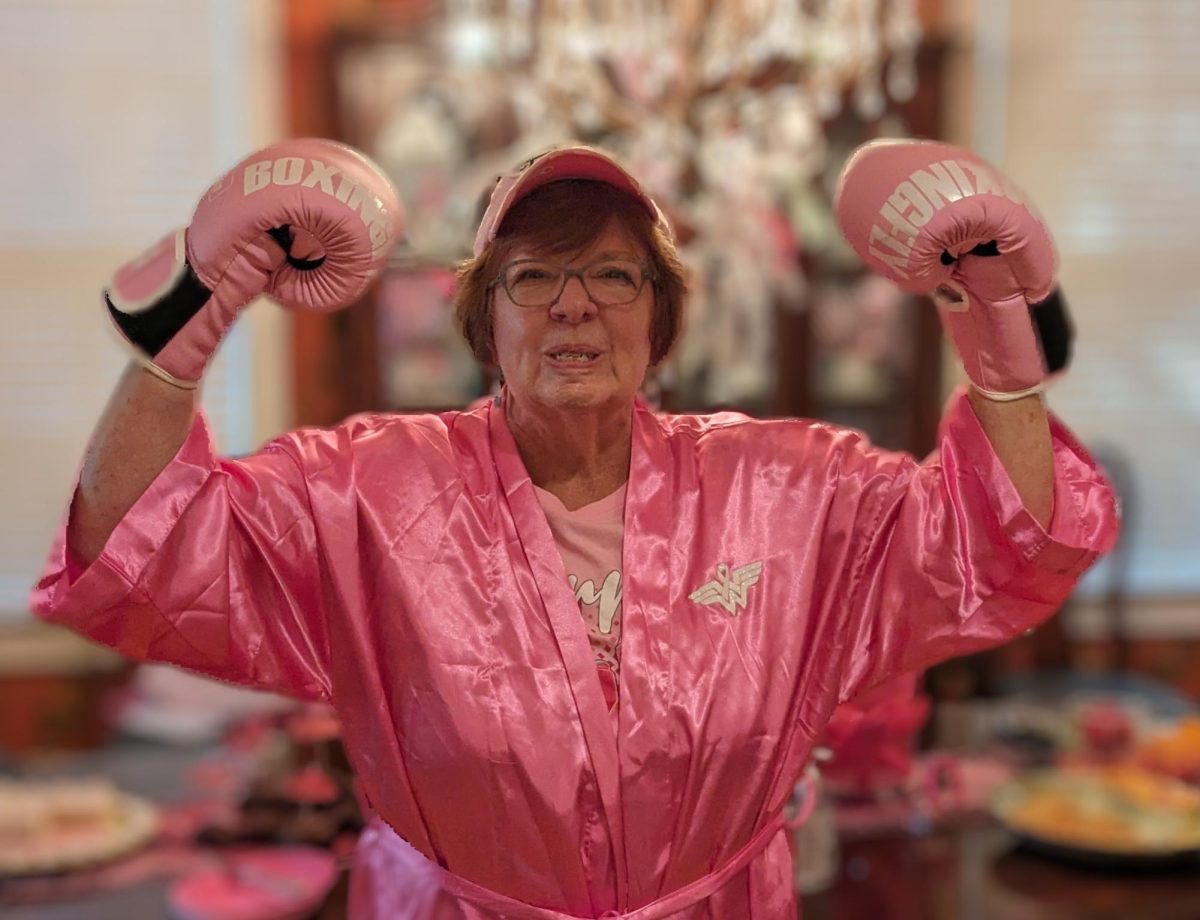
During these different phases of chemotherapy and radiotherapy, she was also prescribed dozens of medications ranging from hormone blockers to oral forms of chemotherapy. This portion of her treatment was one of the only times in her treatment where she began to feel especially bad, but her optimism didn’t falter. Even after losing all of her hair, she excitedly took my grandfather out for a day of wig shopping. She tried on all sorts of cuts and colors before settling on a simple grey wig with bangs.
“I think Puggy (my grandfather) enjoyed it more than I did because he wanted me to try out all these weird wigs, but I decided to go with a grayer look because I always said if I ever lost my hair, I would not color it,” she said.
Her treatment was going splendidly, quite possibly all of the best-case scenarios for all of the reactions to the treatments. Unfortunately, that didn’t last. In my grandmother’s case, it has to do with her second surgery, in which they placed spacers where her future breast implants would go. These “spacers,” also known as tissue expanders, were placed in her chest weeks after her initial surgery to prepare her skin and remaining tissue for the insertion of her implants. While they initially seemed to be working, her tissue expanders began causing pain in her chest.
“The spacers were put in, and they are hard plastic. It was not comfortable. Then, they fill them and stretch your skin so that you can have implants and try to look normal. You could not sleep anywhere but on your back, but I got used to it.”
After another surgery to remove the spacers, she originally got implants, but they didn’t heal properly.
“One of the implants never healed. In fact, I woke up one morning and went to change clothes, and there was a good-sized hole, and I could see the implant. It had just never healed.”
Then, they had to go back into surgery to remove the infected implant. In between these surgeries, the antibiotics attacked her weakened immune system and caused a viral infection known as C. difficile infection, which is a bacterial infection of the colon. “While I was dealing with C-diff, I had to go back into surgery and have that implant removed.”
Throughout her two-year and ongoing treatment, she has remained positive and continued to be very present in her grandchildren’s lives. On Halloween night, she and my grandfather surprised us by dressing in costume as Captain Hook and Mr. Smee, and answered every doorbell, happily giving candy to the trick-or-treaters.
Nana is in her final stages of treatment, making sure all of her lymph nodes remain cancer-free. She was able to ring the bell, a tradition in hospitals that signifies someone has beaten cancer, and has continued her life normally. Everyone’s treatment plan for breast cancer is different, and in many cases, they aren’t able to be as active or spirited as my grandmother was during her treatment.
“It’s all a mindset. I really think a lot of people panic, and I know a lot of people don’t believe in God, and if you don’t believe in God, I don’t know how you do a lot of things, but I trusted that I was going to get through it,” said. “I had a wonderful support system; my family and Poppy were wonderful. He sat me down because after it started, I kept saying ‘oh, I’m sorry but could you get me a glass of water?’ and ‘I’m sorry, I need this.’ Finally, he said ‘Enough, we’re in together, we’re gonna get through this.”
Breast cancer awareness is not just represented by a pink ribbon, fashion show, fundraiser, or race. It is a way to remember those who survived and those who didn’t, and to continue to tell their stories.
This story was originally published on The Saber on December 3, 2025.