





![MORE THAN A GAME. With two diving catches in the outfield, the Lions showed up defensively, aiding in their victory over the Pacers. One catch was made by Atwood, and the other by McGraw. Throughout the game, the Lions knew that it wasn’t just about their victory today. “I think [playing for cancer] makes it bigger than just a game,” McGraw said. “Knowing that you have a bigger impact in this world than just who you are as one person.”](https://bestofsno.com/wp-content/uploads/2026/05/I70A1454-1-1200x800.jpg)


“‘I can see it in your stomach,’” junior Sarah Xu said. “‘You’re so bloated.’ She would go to my mom and she would say, ‘Sarah has to stop eating so much.’”
Inside a fluorescent-lighted studio with a new teacher, 11-year-old Xu had weekly lessons on slippery floorboards. Across the walls of framed dancers, from ceiling to wooden ground, there was a sweeping mirror that reflected Xu’s teacher pointing at her thighs.
Xu was not taught penchés or leg extensions — she was taught an eating disorder (ED). She practiced that to prepare for a recital, starving herself was a prerequisite.
“Hearing someone say those things about me when I was so young was just a really big shock, and it really hurt me so much to the point where I wouldn’t eat for two days,” Xu said. “I wouldn’t allow myself to eat at all because I had to look skinny for the recital.”
After tolerating the cruel critiques into the seventh grade, Xu finally closed her previous studio door behind her for the competitive dance company she originally participated in.
But in the mirror, in the room dancing with her peers, the lingering plague of body dysmorphia fogged her.
“I could feel like myself again, but there was always that underlying feeling of disappointment when I looked at myself in the mirror,” Xu said. “I even had to quit ballet because it was getting to the point where I couldn’t look at myself in the mirror anymore wearing tights and a leotard.”
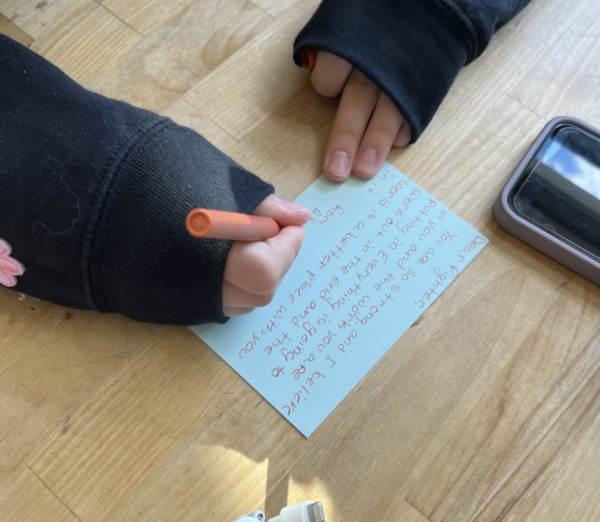
So on July 20, 2025, when president and founder Xu inaugurated The EmpowerED Initiative (TEI) and its 14-day campaign, it was an ode to what she has endured and continues to recover from.
“I got the idea of helping others with what I was also going through,” Xu said. “I realized I wanted to create something that could have a really huge and real impact on others.”
TEI is a registered 501(c)(3) organization and nonprofit, geared to individuals who suffer from EDs and body dysmorphia. Within its recent introduction, it has already amassed an international foundation with over 160 volunteers from Nigeria, Russia, Spain, Canada, France, United Kingdom, etc.
And in one week, Xu amalgamated 15 volunteers from Huron alone.
“Sometimes it was just my friends who would come up to me,” Xu said. “And they came to me and they told me that they wanted to be part of it.”
TEI has four main programs: the Hotline Forum, Hospital Campaign, Ambassadors and Recovery Library.
TEI battles against the toxic diet and body culture that can be found everywhere. It was in the studio of Xu’s former teacher, in the comment sections of an influencer’s “What I eat in a Day”, in the movies consumed as a 5-year-old.
Since elementary school, Siciliano had struggled with her body perception. In eighth grade, it eventually pushed for the cyclic restrictions of an ED.
Restricting and binging and purging, and again.
“Watching movies and every woman looks the same. My own mother who struggled with diet culture,” Siciliano said. “And even if it’s not social media, it’s all around you. And it really affects you more than anything.”
Xu and Siciliano had befriended each other in an AP Government class. Innately, there was a trust in each other where they both disclosed their histories with EDs. As a result, before TEI’s launch, Xu texted Siciliano to offer a board position in the initiative.
Siciliano now regulates the flow of media on the TEI Recovery Library, reading each piece volunteers are assigned.
“I think EmpowerED is very raw. It’s very real. It’s not an easy thing. It’s a very hard, difficult, scary thing,” Siciliano said. “And I feel like The EmpowerED initiative does a great job of showing the truth. The truth around the reality of the disorder instead of putting filters.”
The global influence of TEI is an expanding effort, anticipated to extend beyond post-secondary school for Xu and Siciliano. But in the TikTok comment sections of TEI, there are more local, intimate moments.
“I was expecting zero notifications,” Xu said. “But then I remember, after I posted the first Tiktok, I saw that there were a couple of new comments.”
And Xu opened to the first comment on a TEI post: “This is a great campaign, I’ve never had an ED but I know people who have this and this is so good for awareness. Thank you for doing this.”
“I think just having a real person say that as a complete stranger really made me feel like I was truly doing something for others,” Xu said. “That really spurred me to just continue doing work and working as hard as I could to help as many people as possible.”
But the response has not always been positive — in a conversation with mutual friends, Xu’s peers began discussing her and her friends’ “futile” extracurriculars, remarking on their activities until they arrived at the topic of TEI.
“I just kind of stood there. I didn’t really know what to say,” Xu said. “I was about to speak up, when one of them suddenly said, ‘What’s the other thing about eating disorders?’ And he just said it in a really mocking way.”
But to her, those comments have only helped to augment TEI, a pursuit that represents the environment her and others have been bound inside. All the scopes of spearheading TEI are what encourages Xu to nurture her initiative.
“It’s gut-wrenching, but it also helps motivate me to keep going,” Xu said. “I’m just gonna prove them wrong.”
This story was originally published on The Emery on January 15, 2026.