





![MORE THAN A GAME. With two diving catches in the outfield, the Lions showed up defensively, aiding in their victory over the Pacers. One catch was made by Atwood, and the other by McGraw. Throughout the game, the Lions knew that it wasn’t just about their victory today. “I think [playing for cancer] makes it bigger than just a game,” McGraw said. “Knowing that you have a bigger impact in this world than just who you are as one person.”](https://bestofsno.com/wp-content/uploads/2026/05/I70A1454-1-1200x800.jpg)


It’s 10 a.m. on a Tuesday, and senior Dante Gelles furrows his brows in the middle of a high-stakes negotiation.
But he isn’t in a boardroom or a bank.
He’s sitting in his second period classroom, staring at a trade offer on his iPhone screen under the desk. The deadline is approaching, and he needs a star wide receiver to save his season.
He raises his hand and asks for a bathroom pass, not because he’s ill, but because he needs the privacy of the hallway to finalize a deal that has been 17 weeks in the making.
Gelles’ routine isn’t unusual at Sunny Hills. What began as a popular pastime during the 1960s has grown into a $27.8 billion asset in the sports entertainment industry, with an estimated 84 million people in the U.S. and Canada participating in fantasy sports or sports betting, according to a July 2025 Fantasy Sport & Gaming Association [FSGA] report.
Fantasy sports players participate all over the world on desktop sites and mobile apps like Yahoo Fantasy Football, ESPN Fantasy and DraftKings. Here, fans become the general managers of their teams, building a roster of real-life professional athletes in hopes of beating other made-up groups in their fantasy leagues, according to Philanthropic Fantasy Sports.
Leagues can typically range from two to 20 players, but the standard size is 10 to 12 teams per league. Although they don’t physically go against each other, they compete based on the statistics those players produce in their actual games.
At Sunny Hills, Lancers get serious about fantasy sports, where managing a virtual roster can turn into an all-consuming passion. To them, it’s not just a game, but a way to connect, compete and celebrate.
FANTASIES COME TO LIFE
The footprint of fantasy sports on the modern entertainment industry is rooted in a history spanning over 60 years, according to a Fantasy Index article.
According to FootballDiehards.com, the first fantasy football league dates back to 1962, when Wilfred Winkenbach, a former owner of a minority stake in the Oakland Raiders, created the Greater Oakland and Professional Pigskin Prognosticators League [GOPPPL].
The core concept of the GOPPPL remains similar to modern-day fantasy football: drafting a team of players and competing based on their weekly performances. Still, differences ensue; according to an August 2017 article from SB Nation, before the internet was invented, players had to manually compile scores and statistics and submit their rosters to a league commissioner in writing every week.
Then in the 1980s, things began to change.
First public editor of The New York Times, Daniel Okrent, founded the first fantasy baseball league in 1980, called the Rotisserie League, according to the FSGA. What started as a fun game for 11 baseball fanatics expanded through media, how-to guides and more to baseball fans all across the country.
THE RISE: FANTASY GOES ONLINE
Soon after, the official birth of the internet in 1983 opened new doors for fantasy sports.
According to an article on Sleeper, a modern fantasy gaming platform, the once-analog system first moved online in 1985, when The Grandstand Sports Services began hosting the first public fantasy football leagues. Then, in 1997, CBS.com changed the game as the first prominent media company to host leagues, leading to more mainstream attention.
From that point on, platforms like Yahoo! made free fantasy leagues available to anyone with a connection, allowing millions to draft and manage sports teams online. Other platforms such as Sleeper, ESPN Fantasy, Daily Fantasy Sports and NFL Fantasy arose since, and many expanded to every kind of sport, not just football or baseball.
“There’s even fantasy Formula One [F1], which is kind of crazy,” said junior Leona Ashley, who doesn’t play fantasy but watches F1 as a sport. “It’s cool that every sports fan can have [all the players] in one spot and see where they fall on the charts.”
BEYOND THE DATA
After five years of intense competition with his middle school friends, Gelles sums up the experience simply.
“One word: awesome,” Gelles said.
While typical sports video games like 2K and the rebranded Electronic Arts Sports Football Club allow players to control the physical movements of athletes, fantasy sports demand a different kind of engagement: data-driven trust.
“It is similar where you can play as your favorite players,” said junior Kirsten Leopaldo, who observes the game as a non-player. “But it’s also unique because you don’t control them to earn points; you have to rely on how they will actually perform.”
This reliance on real-world outcomes shifts the game from a test of “button-mashing,” rapidly pressing controller buttons, to a test of “ball knowledge,” a deep, nuanced understanding of a sport or general subject.
For the self-declared sports fanatic, senior Anthony [AJ] Fiorini, the allure lies in proving his understanding of the sport.
“You want to show that you know the most about the sport you’re playing in, and you go against your friends and talk a lot of trash to each other while watching more games than you normally would,” Fiorini said. “It’s kind of more fun in that way.”
As the manager of their own rosters, fans-turned-managers continue to manage their teams throughout the season by deciding the lineup, “firing” and “hiring” new players who weren’t drafted by anyone else and trading players with other fantasy players.
Fiorini said he likes to see how far he can test the waters.
“I’ve been offered money, I’ve offered money,” Fiorini said. “I’ll try and finesse some of my friends and give them a whole sales pitch; I’ve almost gotten to the point of making a whole slideshow.”
Gelles agreed with this effort, explaining that nine times out of 10, fantasy sports is the main topic of conversation. He said the obsession stems from the heightened stakes; like betting, fantasy sports creates a personal investment in every play, turning a random Monday night game into a season-defining event.
“If your team does bad, it ruins your week; if your team does good, it makes your entire week,” he said. “This season, I’m not going to lie, I spent more time looking at the app than doing my homework, 100%.”
However, for faculty members who have watched the game evolve from in-person drafts and desktop computers to smartphone apps, the allure is less about the trash talk and more about social preservation. Basketball coach and Korean teacher Joe Ok, who started playing when the first online versions debuted, noted that while technology has made information more accessible, the core value remains the same.
“The great thing about fantasy sports is that it allows you to keep in touch with people I don’t see often,” Ok said. “I have a lot of friends that I went to high school with, and we still play together.”
Gelles echoed this, crediting the game with keeping his middle school friend group intact after they split up for high school.
“I think fantasy, on a grander scale, is what held my friend group together because we all went to different schools,” the senior said. “So indirectly, fantasy has led to a bunch of different memories that are not about fantasy.”
Sophomore Devan Rosete started playing in his freshman year with his football teammates and said it brings a new energy to his team, bringing the virtual fire of the rosters into everyday conversations.
“When it’s during the season, it’s always the conversation topic,” Rosete said. “When we’re not playing fantasy, we’re just chill, but when it’s fantasy time, we’re competitive, and we’re pushing each other to win.”
Despite its ability to bridge distances, the game still faces a significant demographic gap. While the FSGA reports that 35% of players are women, the culture at Sunny Hills remains heavily male-dominated.
Leopaldo, who has heard her friends discussing the simulation’s business but never took part herself, said the subject simply does not align with her interests.
“While it does seem fun and I like the concept, I’m not invested in sports like that, so I would honestly just not know what I’m doing,” Leopaldo said. “I think that, through promoting it in a different light, the game would be more interesting for girls.”
THE MANAGER’S PAYDAY
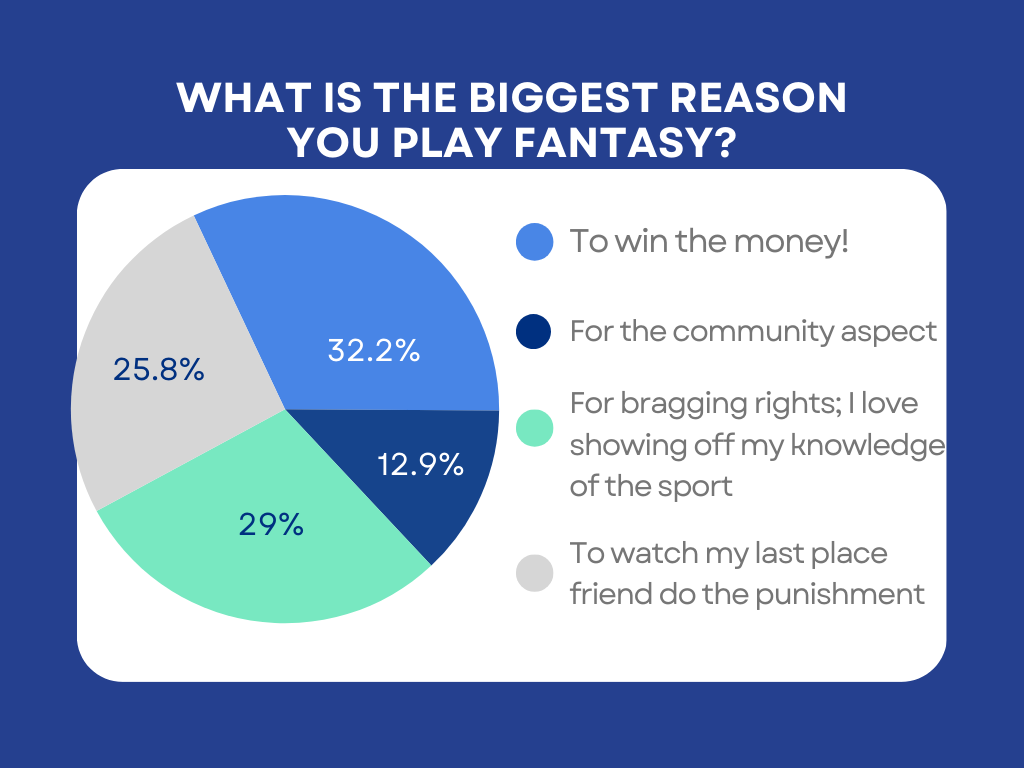
Still, for many participants, the competitive nature of fantasy sports can’t help but stem from the allure of the tangible incentive: the prize.
According to a December 2023 study from the National Library of Medicine, 56.67% of players participate specifically to make money. While the FSGA notes that state and federal laws do not define the hobby as gambling, its similarity to the latter is debatable.
At Sunny Hills, these buy-ins are modest but significant enough to dictate the season’s intensity.
Gelles said he typically competes in 10-player leagues with a $30 entry fee, creating a winner-takes-all pot of $300. Fiorini said his league follows a tiered structure, where a $20 buy-in results in a $140 first-place payout and a $60 consolation for the runner-up.
While some students, like Rosete, said they choose to play without financial stakes, others see it as the missing link for broader participation. Leopaldo said that financial incentives could bridge the demographic gap.
“I think females could be more interested in playing if there were better incentives for it,” Leopaldo said. “Money is definitely an appealing one.”
As players transition from high school to adulthood, these stakes often scale with their income.
Ok said that for some high-level players, wagers can reach thousands of dollars, though he views the money more as a seasonal reward than a high-stakes gamble.
“One of the leagues I was in, years ago, I won, and it was like a nice little Christmas bonus,” Ok said. “It’s become a really big thing; now you can actually wager money, so this was and is the best thing for sports fans to play with their other sports fan friends.”
However, for the high school demographic, the threat of losing cash is often secondary to the threat of social embarrassment. As Gelles noted, while the $300 pot is a motivator, it is not the ultimate allure of the players’ desire to win.
“The main thing is the punishment,” Gelles said. “It’s way funnier than losing $30.”
MILK MILES AND DOG CAGES
For Lancers, the incentive to avoid last place is equally high, if not higher, especially with extreme dares like the dog cage. According to the FSGA, 68% of fantasy players spend money on a league punishment.
At Sunny Hills, students participate in avant-garde ways. For Gelles, finishing last resulted in a “milk mile,” a physical challenge to chug a gallon of milk during a timed mile run.
“I threw up 11 times,” he said. “It gets pretty bad, but that’s what makes it fun.”
Other leagues create social or endurance-based consequences. In Fiorini’s league, he said the last-place manager goes into a dog cage while other league members pour various items of their choice on the person inside. In senior Scott Lee’s league, he said the two participants with the worst records must spend 12 hours inside an IHOP restaurant.
These stakes, while unconventional, ensure that participants remain active in their roster management from the first week of the season until the final championship game. Rosete said the game wouldn’t have the same allure without it.
“I think it’s very necessary [to have a punishment] because if there’s no punishment, then there’s nothing on the line to make you keep trying to win and have more fun and look forward to not having to do a punishment,” Rosete said.
However, since there are no established rules for creating these league-specific incentives, it is unclear where to draw the line.
“The ones I’ve seen on TikTok are like, if you lose, you have to stand in front of your ex’s house and take the picture from ‘The Notebook,’” Ashley said. “That’s horrible.”
She said that while these activities are based on group consent, the burden of safety remains with the students. Still, the nonplayer sees both the risk and the fun in participating.
“Honestly, if that’s how they choose to live their life, that’s their business,” she said. “I think it can be dangerous, but at the end of the day, the responsibility falls on them for whatever happens.”
Despite the commonality of these consequences, not every league relies on fear to drive competition. Sophomore Jaiden Lee, who has played for two years, said that the core mechanics are enough to keep the drive to win high without the extra incentive.
“I don’t think we’ve done punishments at all in the last two years,” Lee said. “It’s just more fun, casual, but the competitive energy is still there.”
FANTASIZE THE FUTURE
As the current season concludes, both faculty and students said they agree that the virtual sport is unlikely to lose its momentum. In fact, the next generation of players — those 13–20 years old — are entering the hobby earlier and with more intensity than previous generations.
According to the FSGA, the average starting age for these players is 14, and 91% of them expect to continue playing next year.
For students like Fiorini, the game’s longevity is tied to its deep-rooted competitive nature.
“It’s like the same thing as betting; betting will never go away, and I don’t think fantasy will ever go away either,” Fiorini said.
While the competitive spirit remains constant, the technology used to facilitate it continues to expand. Lee noted that the shift from paper to digital has removed the traditional limits of the game.
“I feel like with the increasing number of apps and websites, it’s growing even larger,” Lee said. “Back when it was on paper, it was really limited, but now, it’s going to just keep growing.”
Not only did it remove limits, but it is also continuously surpassing them. As the industry looks toward the future of sports entertainment, fantasy sports have already begun to integrate artificial intelligence [AI]-powered predictive analytics and immersive virtual reality, with platforms like RotoBot and Fantasy Points AI.
And the growth seen through these expansions isn’t limited to a single demographic. Ashley observed that the community is diversifying beyond the traditional player base.
“I don’t think it’s going to die out,” she said. “I don’t think it’s just high school boys playing these things anymore, but it’s everyone — old, young and maybe more girls in the future.”
Whether it is for the statistics, picking the dream rosters or the simple desire for a shared experience with the community, the allure of fantasy sports has become a permanent fixture of sports culture.
“I would recommend this game to anyone, especially if they have a group of friends,” Rosete said. “It’s just a great experience for the whole group to get together and have a game that lasts 17 weeks.”
This story was originally published on The Accolade on February 19, 2026.