





![MORE THAN A GAME. With two diving catches in the outfield, the Lions showed up defensively, aiding in their victory over the Pacers. One catch was made by Atwood, and the other by McGraw. Throughout the game, the Lions knew that it wasn’t just about their victory today. “I think [playing for cancer] makes it bigger than just a game,” McGraw said. “Knowing that you have a bigger impact in this world than just who you are as one person.”](https://bestofsno.com/wp-content/uploads/2026/05/I70A1454-1-1200x800.jpg)


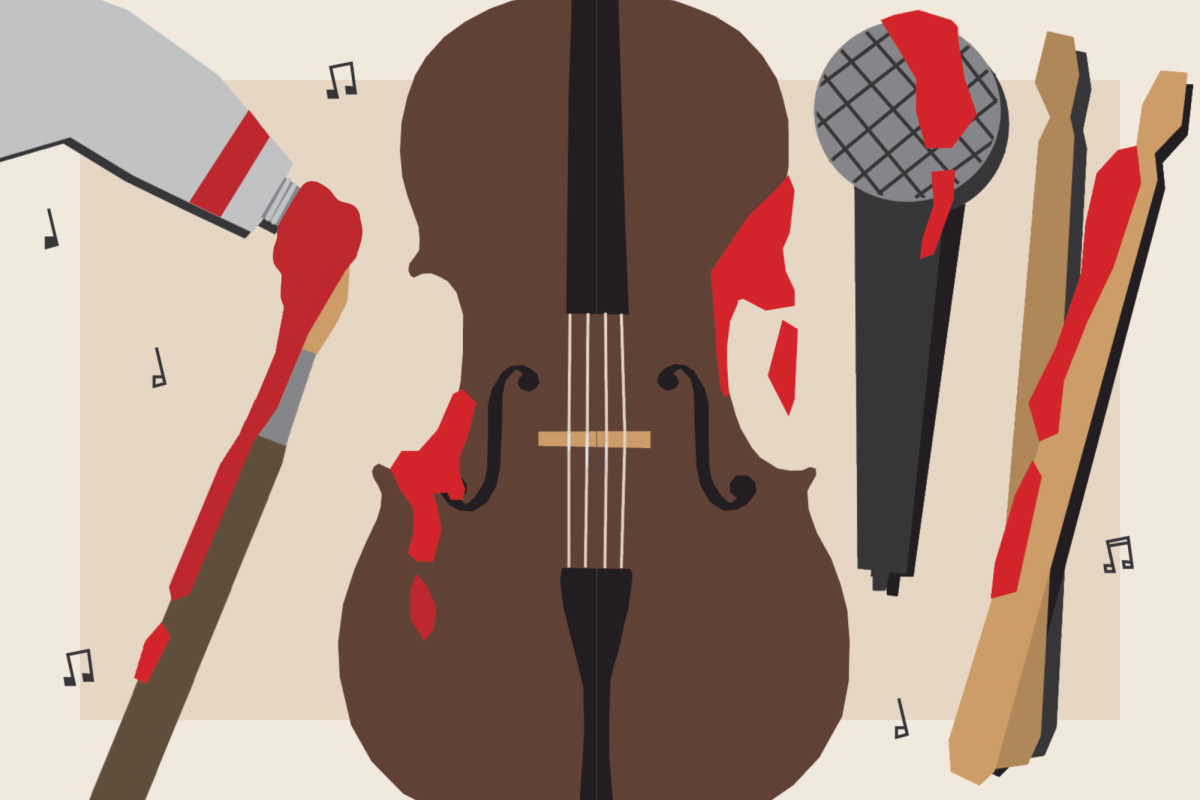
On any given night in Iowa City, poetry drifts through the narrow aisles of Prairie Lights Books, actors take their bows at The James Theater and musicians slip through glass doors into the Voxman Building. Iowa City’s devotion to the arts has shaped its cultural identity, earning recognition in 2008 from the United Nations Educational, Scientific and Cultural Organization as the first UNESCO City of Literature in the United States.
That designation rests on a storied artistic lineage. At the University of Iowa’s renowned Iowa Writers’ Workshop, literary luminaries like Flannery O’Connor, Kurt Vonnegut and John Irving once honed their prose. Beyond the university, generations of poets, playwrights and musicians have passed through local bookstores and theaters, carrying the city’s creative spirit beyond the banks of the Iowa River.
Although Iowa City is known for its arts, that legacy does not begin in lecture halls or publishing houses, but in classrooms. At West High, the arts remain a central, if not understated, force in student life. From student-led ensembles and West Singers to Theatre West productions and AP Art and Design, students encounter a breadth of creative opportunities rarely matched in surrounding districts.
However, even in a community celebrated for creativity, the future of the arts is precarious. Nationwide, arts programs in public schools are often among the first to be cut when budgets tighten or academic priorities shift. In that climate, the continued presence of arts education continuously relies on the teachers and advocates willing to defend its value within schools and communities.
At West, one of those advocates is Orchestra Director Jon Welch. Welch, who also serves as the district’s performance music content lead, has spent over two decades in music education and has shaped students’ growth on and off West’s stage for 10 years. He notes that the arts have helped his students develop technical skills, personal confidence and a collaborative spirit.
“My favorite part of my job is not the concerts, it’s the everyday — coming together and working,” Welch said. “Kids can see the problem ahead of them and get frustrated, but then [I get] them to push through and do it together as a team.”
Welch believes the arts offer an increasingly rare reprieve from the academic environment. Music provides students with a creative outlet where exploration and expression matter more than numerical success.
“Kids see [orchestra] as a way of relieving stress. Every day, we come together to make something beautiful, and we need more of that in the world,” Welch said. “We’re teaching kids how to come together over a large project, how to make something that’s beautiful and to be active in the process — the process isn’t about something that’s going to happen down the road. The daily in-and-out of it is equally as important.”
West cellist Ellie Roetlin ’26 agrees on the importance of the arts in schools, citing its personal impact on her. Roetlin has played the cello since she was three years old and now sits first chair in West’s Symphony Strings’ cello section, the top orchestra at West.
“I find value and enjoyment in playing as part of a group. When things come together, it’s just really special,” Roetlin said.
As a four-year orchestra member and chorister currently in West Singers, Roetlin describes the arts not simply as an activity, but as a place of belonging.
“West’s performing arts are really inclusive. Once people join choir, band or orchestra, I don’t think that they feel left out. A lot of people are welcomed in,” Roetlin said. “It’s way more accessible here than anywhere else.”
For Welch, who grew up in a middle-class household, accessibility is one of the most critical — and most overlooked — functions of public school arts programs.
“My family wasn’t the sort that would have started me with violin lessons when I was two,” Welch said. “The only way that we knew how to get involved with [orchestra] was because of the programs in the public schools and the teachers that were actively recruiting.”
Drawing on years of experience in music education, Welch sees arts programs as spaces where students develop not only artistic ability but also discipline and a sense of identity that emerges through their work.
“Kids want to be good at something,” Welch said. “When you’re able to push them to a high level, they understand it, and they deeply cherish it.”
Roetlin supports this idea, citing arts programs as being important to development, as well as crediting her personal motivation and success to her time as a musician.
“Students would lose a lot of culture in the school [without the arts]. There’s history in music. There’s emotion in music. There’s hard work in music,” Roetlin said. “Music has a really big role in who I am today. It has taught me almost everything about the world. My [cello] teacher pushes me to work as hard as I can, and that’s taught me about discipline and what it takes to be successful.”
While some students perform, others construct the world behind the performance itself. Hyunsuh Lee ’26, head of Theatre West’s set crew and an AP Art and Design student, works in the space between imagination and reality, with one of their biggest projects being from the program’s rendition of the play “Peter and the Starcatcher” in December.
“I like working with my hands. I like doing something active and being part of this community,” Lee said. “For ‘Peter and the Starcatcher,’ I made the giant crocodile head that burst through the middle of the stage. I traced it out from a projection, cut it out and painted it. I was the one inside the crocodile head during the play. It’s like my child — it’s my magnum opus.”
Lee notes that the work is rigorous — tracing, cutting, assembling, painting — and often goes without recognition until the final moment.
“When you have seen it bare, as just a skeleton, and you don’t see the vision until it is all together, there is a sense of astonishment,” Lee said. “Sometimes the process of art and creating can be so painful, but there’s nothing more rewarding than being able to see it finished.”
A production, no matter how intricate its set or dramatic its score, is nothing without the actors that move through it. There can never be a show without its cast of characters, and where William Seberger ’28 thrives is under the spotlight. Seberger values the inclusive attitude that West holds toward the arts, whether one is an artist or an observer. As a bass singer in West Singers, a member of the Technology Student Association and a football player, Seberger occupies spaces that are often perceived as contradictory.
“When I tell people on the football team that I do choir or theater, they don’t treat it as a negative thing. They don’t judge me for it,” Seberger said. “We’ve built a community that is so accepting of people who are interested in all different types of things. You’re bound to interact with people who are different from you and have different interests.”
Seberger divides his time between building projects for competitions, rehearsing for the school play and running drills on the football field.
“Having that balance between [art and STEM] is a really good way to help me make sure that I become a well-rounded adult,” Seberger said.
Studies conducted by Johns Hopkins University found that students who participate in both arts and STEM activities tend to experience enhanced cognitive flexibility, improved problem-solving skills and stronger mental health outcomes compared with peers who focus on only one domain. Engaging in multiple forms of learning allows students to exercise both analytical and creative thinking, while also providing emotional outlets that reduce stress and improve mood.
For Lee, the benefits of creativity extend beyond cognitive development and into spiritual and emotional growth. As someone who engages in the arts daily, Lee sees it as an integral part of the human experience.
“There are people who think that not all art has meaning. I do not believe that,” Lee said. “There’s art that goes into cinematography, social media or children’s books, and they have meaning to us. We are shaped by the art around us. Art makes us feel, and we make art because we feel. It’s that back-and-forth relationship.”
Despite these benefits, arts programs across Iowa face mounting financial pressure. In January, the Boone Community School District in Boone, Iowa, laid off its only high school orchestra director to save $650,000 in the upcoming school year, dismantling a program that had existed for more than a century.
“They used to have two orchestra directors. One of them retired, and they never rehired that position. Once we got back from winter break this year, the other orchestra director was told that they wouldn’t have a job there next year. By eliminating that position, they eliminated that entire program,” Welch said. “It was due to a lack of funding, but it was a choice that they made at the expense of that entire program.”
Welch has a long history of music advocacy, as the former president of the Iowa String Teachers Association and a current executive board member of the Iowa Alliance for Arts Education.
“Advocacy can mean a lot of different things. Promoting your programs, having conversations and relationships with the community and the leaders in your community — that’s advocacy,” Welch said. “It’s inherently baked into being a teacher, and into these leadership roles that I’ve served.”
Even when programs survive, the question of pursuing a career in the arts remains fraught, as over half of students who have doubts about choosing a major consider salary after graduation and job stability as the root of their skepticism. Lee, who hopes to study art in college, acknowledges that uncertainty while expressing a determination to create.
“It is scary to think about pursuing art as a career, because it’s in a very tumultuous time right now with AI art and everyone thinking there’s no career in art,” Lee said. “But I just feel like, if I’m not creating something, I’m wasting away.”
Another problem for Lee is the financial cost of an artistic career. In the 2022-23 academic year, the majority of the top 15 schools with the highest average annual net cost were specialized art colleges. Meanwhile, students who pursue performing arts degrees rank second-lowest in income five years after graduation, with a median of $38,000 a year.
“Art school is crazy expensive, especially if you’re going to an out-of-state school. It’s a very competitive industry, so you need to find your niche, and you need to be good at it to make a living,” Lee said. “Art’s expensive. The materials are expensive. Everything just costs so much.”
For seniors like Roetlin, choosing a path in the arts involves balancing passion with practicality. Committed to St. Olaf College to study cello alongside economics on a pre-law track, Roetlin points out the challenge of pursuing a field that is difficult to quantify in terms of impact.
“[STEM is] easy to measure,” Roetlin said. “Say someone writes a research paper, or something in the STEM field. [They have] this list of accomplishments. But it’s hard, when you’re listening to a symphony, to understand it unless you are in that field. It’s easier for anyone who’s not in the field to not understand the importance of it.”
Seberger echoes this idea, agreeing that STEM’s visible effects on society cause it to be perceived as more important than the arts.
“STEM is more easily visible, and that’s why people associate it with being more valuable. You can see the car that you drive or the building that you live in, but you can’t see what music does to somebody else’s mind or their soul,” Seberger said. “[That] puts some doubt in students’ minds [about whether] what they want to pursue in life is what they should pursue. It might give them a little guilt about putting their skills toward something that doesn’t have as direct an impact on the world.”
At the University of Iowa, around 64% of theatre majors double major in a different field. This practice isn’t uncommon for arts majors, who are often encouraged to also study in more practical routes as a backup in case their original plans fall through.
“People don’t think that careers in music are worthwhile because they might not make you as much money as STEM. I felt discouraged throughout my decision-making to choose music because it’s hard to plan your future with it. Me and my family think about it a lot. It’s been a huge factor in my decision-making for school,” Roetlin said. “My teacher also has expressed [that] you can love music and you can pursue music, but it’s also a good idea to have a second major.”
As an aspiring artist, Lee has also felt pushed toward a double major, specifically by his parents, who want to support his creativity while ensuring his life’s stability.
“My parents are, of course, supportive to a degree, but they are also Korean,” Lee said. “I get this idea of, ‘You’re my child, so I still support you, but what if you became a lawyer?’ They’re like, ‘Why don’t you double major and be a lawyer-artist?’”
Although Seberger is younger than Roetlin and Lee, he currently plans to pursue music in college, but not with the same level of focus provided by a major.
“I would like to minor in something choral in college. That would be very fun,” Seberger said. “Choir is one of my favorite things to do in the whole world, and I don’t know what I do without it.”
Rather than pursuing it as a professional career, many high school graduates continue to engage in music through local or collegiate ensembles. These groups allow for STEM-focused students to continue playing in a way that demands less time.
“There’s never a point in your life when you retire from [the arts]. It’s something you can always take with you,” Welch said. “Some of the best collegiate orchestras are ones where folks aren’t even majoring in music. A former director from around here conducts at Vanderbilt [University], and his orchestras are incredible, and they’re made up of people studying [medicine].”
Welch, who has successfully made his career out of music education and conducting gigs, finds that an exchange between stability and interest is worth the hustle if a musician is truly passionate about their forte.
“You can have a very fulfilling life working in music. You might not make the most money in the world, but if what you value is being fantastic at playing, you can certainly have a very good life. It can be hard. You have to know that you will absolutely love it,” Welch said. “Our society values making money over joy sometimes. If you have a good perspective of what you want to get and realistic expectations, you can have a happy life.”
Following a long line of successful performances at venues like the John F. Kennedy Center for the Performing Arts and Carnegie Hall, West’s Symphony Strings was recently accepted to perform at the 2026 Midwest Clinic — the largest music education conference internationally — in December. Roetlin cites Welch as the primary reason for the quality and exceptionality of West’s orchestras.
“Welch makes it really special,” Roetlin said. “He devotes a lot of time and effort into the orchestra. It helps us go really far, further than if he just didn’t care.”
Drawing on his time with West’s choir and show choir programs, Seberger also views the choir teachers as role models, specifically on their success in the musical industry despite a push for STEM careers. West Choir Director Luigi Enriquez holds both a Bachelor of Arts and a master’s in music education, while his co-director, Dr. David Haas, has attained a doctoral degree in music education.
“I see [stigma against the arts] online, but I also see people like Dr. Haas, and I see how he’s getting by just fine,” Seberger said.
In line with Roetlin and Seberger, Lee cites the art teachers at West — Christian Aanestad, also the district’s curriculum coordinator and content lead and Molly Sofranko — as the largest supporters in his professional pursuit of art, providing him with connections and endless encouragement.
“Christian and Molly opened opportunities for me to learn more about art colleges. As part of AP Art this year, we went to a National Portfolio Day event. A bunch of art programs from colleges came, and you could show them your portfolio, and get comments. I even got introduced to an art college that I got accepted to,” Lee said. “I wouldn’t have had that opportunity if not for them. That made me think, ‘Maybe I do have something here. Maybe I can do this.’ They’re so supportive of [us] that it’s really easy [to have] confidence in yourself.”
Along with financial problems and societal stigmas, artists face an emerging problem: artificial intelligence-generated art. AI art has become popular in the last few years following the widespread availability of text-to-image models. Many believe that the growth of AI art spells disaster for artists, predicting a lower work demand in the future. However, Lee takes a different approach despite recognizing the negative effects of machine-generated art.
“When AI really started to get big, and started to get good, I started to doubt myself and doubt art,” Lee said. “Time will tell what will happen, but I don’t think art as a whole is in danger. With new technologies, there’s going to become new ways that we create art, or we’re going to create new art in new ways, and with AI, it’s tough, but the hype will die down. AI art cannot create new ideas, or remix ideas [that are] creative and inventive the way human artists do.”
Roetlin agrees, as she believes that AI’s lack of ambition bars it from taking the spot of human artists.
“I don’t think AI will take over music because human passion is irreplaceable, and it can’t be replicated,” Roetlin said. “I saw a video of an AI robot playing the violin, and it was technically perfect. The vibrato was great, the intonation was perfect — but it had no spark.”
Roetlin ensures that she will still be able to enjoy music, even if not as a career. In her eyes, the sacrifice only makes the love for it grow stronger.
“I feel encouraged to pursue music because of my passion for it,” Roetlin said. “I know that if it doesn’t work out, I’ll still love music. That won’t go away. I won’t have to leave that part of myself behind.”
Regardless of whether students pursue careers in the arts, the impacts of these programs persist in the discipline and sense of belonging that they foster. Yet, these opportunities are no longer a guarantee. As funding decisions continue to reshape public education and its systems, the future of the arts will ultimately depend on whether communities choose to recognize their value before they are gone.
At West and beyond, preserving the arts is not just about honoring tradition, but about protecting students’ ability to express themselves in creative ways that no other subjects can emulate. If communities want to remain places where artistry thrives, they must continue to invest in the students who carry that legacy forward.
This story was originally published on West Side Story on April 23, 2026.