




![MORE THAN A GAME. With two diving catches in the outfield, the Lions showed up defensively, aiding in their victory over the Pacers. One catch was made by Atwood, and the other by McGraw. Throughout the game, the Lions knew that it wasn’t just about their victory today. “I think [playing for cancer] makes it bigger than just a game,” McGraw said. “Knowing that you have a bigger impact in this world than just who you are as one person.”](https://bestofsno.com/wp-content/uploads/2026/05/I70A1454-1-1200x800.jpg)


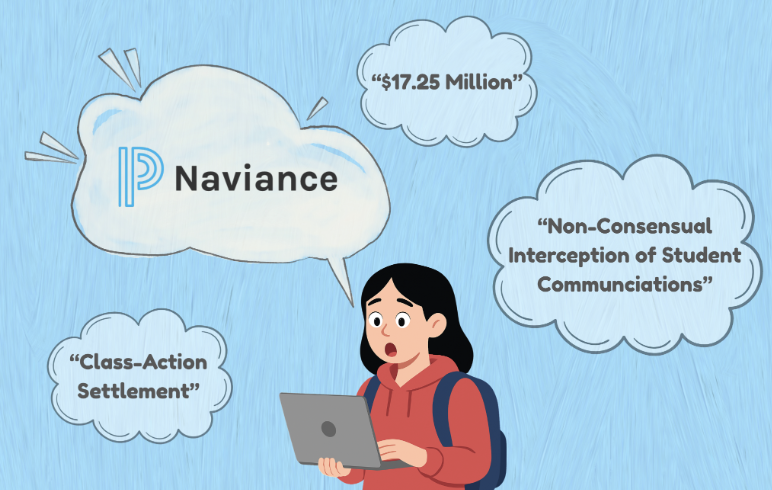
Students learned April 30 of a court-authorized notice stating that they may be entitled to a class-action settlement after Naviance allegedly shared private student information.
After scanning the email, they were informed that Naviance, now owned by PowerSchool, allegedly collected their data through third-party analytics tools without proper consent or disclosure—making students eligible to file a claim and be a part of the $17.25 million settlement. The lawsuit was initially filed in the U.S. District Court for the Northern District of Illinois in the fall of 2023.
Though the lawsuit was surprising, it was not unexpected. There has been a pattern of privacy concerns regarding PowerSchool and its platforms. Last year, Chief Technology Officer Jordan Salus announced in an email to students and parents that there had been a data breach that impacted students nationwide. The breach allowed unauthorized access to the student information system (SIS) customer data, which included data from Districts 67 and 115.
Though PowerSchool users were not informed specifically what personal information of theirs was exposed, the educational technology company maintains control over very private information, including enrollment data, IEP or 504 status, attendance records, grades, and parent contact information.
Junior Claire Maguire, who once used Naviance monthly for college research and planning, said she feels her personal information is not being adequately protected.
“Personally, I had to do my own research to inform myself about the lawsuit, and I don’t think I was provided with enough information upfront to understand the situation,” Maguire said.
Maguire wasn’t made aware of the class-action lawsuit until she received the legal notice from Kroll Settlement Administration in her school inbox.
“The situation makes me a little nervous about how much information is not being told to us or if there is a further explanation coming,” Maguire said.
Similarly, junior Isabella Montinari was confused by the situation and wasn’t exactly sure what the legal notice would mean for her.
“I think [the administration] should probably be more transparent with where our data goes and how it is used,” Montinari said.
In response to the notice, the district sent out a press release on Friday in which Mr. Salus explained how the district was not notified of it being sent out to students until it had already arrived in their inboxes. He also clarified to students and parents that a data breach did not occur.
“These [analytics tools] are commonly used across websites and online platforms; the legal question centers on whether their use in a school-based platform was appropriately communicated and permissible,” Salus wrote.
In the midst of these privacy concerns, Salus said the district is continuing to re-evaluate security measures.
“As part of our ongoing practice, we regularly review the digital tools we use, evaluate vendor privacy standards, and implement safeguards to maintain secure systems, such as two-factor authentication, regular access reviews, and third-party security assessments to protect student data,” Salus wrote.
Currently, PowerSchool continuously denies any wrongdoing, and both parties have agreed to settle the lawsuit to avoid the uncertainties and expenses associated with ongoing litigation.
“As part of their agreement to settle, the plaintiffs will generally agree to language stating that the defendant does not acknowledge any wrongdoing because ultimately, most plaintiffs just want to get some money and move on with their lives,” Law Teacher Mr. Mann said.
A student, even if they are under the age of 18, still has the right to opt in to the settlement, although this action must be taken through a parent or guardian.
“Generally, courts will provide extra scrutiny to class-action settlements involving minors to ensure they’re fair and reasonable,” Mr. Mann said.
A preliminary estimate by the plaintiff’s attorney, Scott R. Drury, is that each student who files a claim could receive about $50, depending on how many students apply, as first reported by the Parent Coalition for Student Privacy.
As of this semester, counselors have begun instructing students to use Maia Learning, a college platform similar to Naviance that utilizes AI to assist students in the college search process and teachers in writing letters of recommendation.
However, there has been no formal communication from the district as to why the switch occurred, or if Maia’s AI tools are able to protect the student data and privacy it has access to.
Undeterred by the prompt press release following the settlement notice, students remain unsatisfied with the lack of transparency as events were unfolding—believing that earlier communication could have supported them better in understanding the situation and helping them decide whether to continue using Naviance.
As schools continue to embrace new digital tools, this evolution raises broader questions about how student data is used and a school’s responsibility not only to protect the privacy of students but also to ensure they understand the full risks associated with using digital platforms.
Eligible students can participate in the settlement by filing a claim no later than July 27 on the court-authorized settlement website.
This story was originally published on The Forest Scout on May 3, 2026.