





![MORE THAN A GAME. With two diving catches in the outfield, the Lions showed up defensively, aiding in their victory over the Pacers. One catch was made by Atwood, and the other by McGraw. Throughout the game, the Lions knew that it wasn’t just about their victory today. “I think [playing for cancer] makes it bigger than just a game,” McGraw said. “Knowing that you have a bigger impact in this world than just who you are as one person.”](https://bestofsno.com/wp-content/uploads/2026/05/I70A1454-1-1200x800.jpg)


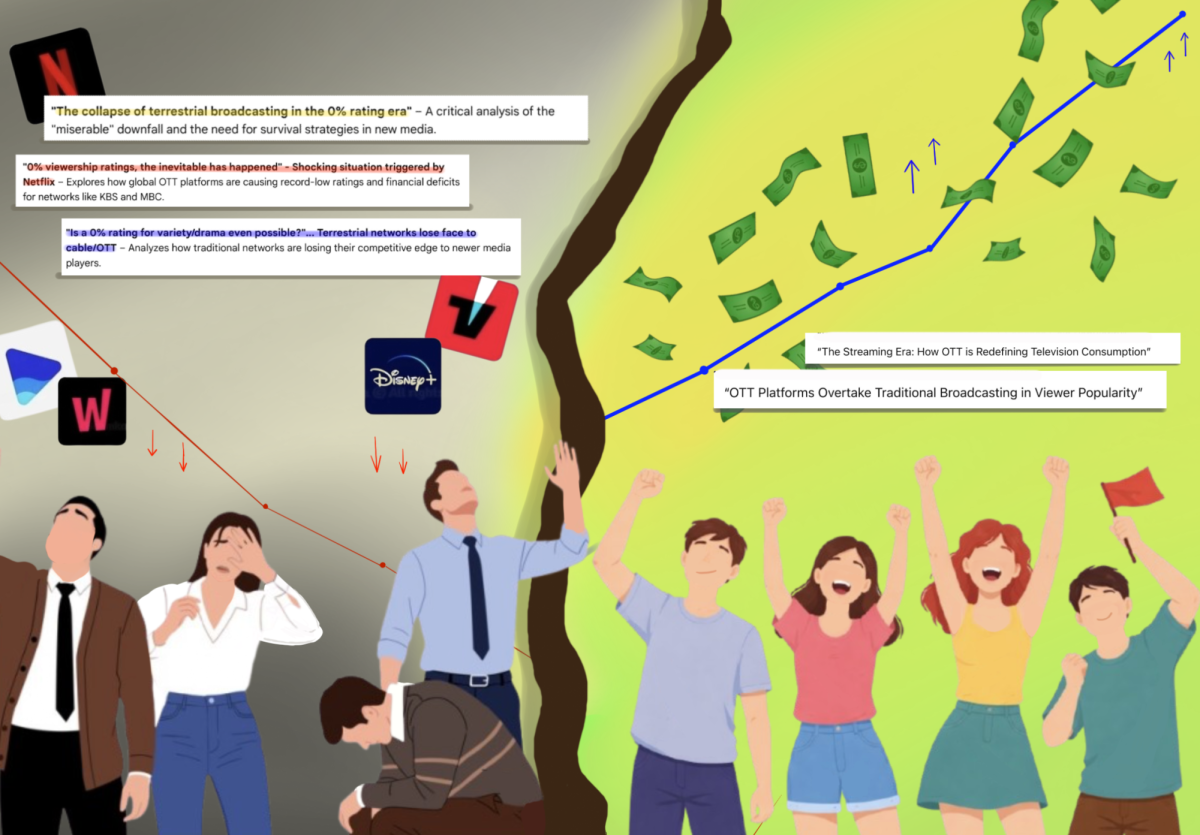
In the golden age of “Hallyu”, the K-culture wave, Korea’s entertainment industry pushes past its borders and dominates global screens. Yet behind the international acclaim, domestic broadcasters face mounting pressure to match sky-high production standards in a media economy transformed by global streaming platforms.
Korean content reached international audiences through streaming services as Netflix and Disney+. Dahee Jeong, Information Sciences professor of Dongduk Women’s University, said, “In the past, dramas had a small target audience limited to Korea. However, with the rise of streaming, dramas reached global viewership, which eventually raised the standards to meet the international expectations.” Accordingly, recent projects like TVN’s “Ask the Stars” and Disney+’s “North Star” recorded budgets of over 50 billion won and 70 billion won, respectively.
Platforms that expanded access also weakened the influence domestic broadcasters once held over content trends. Jiyun Yoo, a contributing journalist at Banrondotcom and a doctoral candidate at Chung-Ang University, said, “They no longer control the content trends, and follow and repackage existing trends that have already gained popularity on OTT [streaming] platforms.”
To buffer financial risks from high production costs and potential box-office bombs, companies scramble to secure stable revenue with guaranteed margins. For domestic broadcasters, however, stability has become a luxury. Unlike streaming platforms, which secure 10% mark-up through pre-investment models, traditional broadcasters rely largely on product placement revenue and local viewership ratings that fluctuate with performance.

Amidst this instability, domestic production volume cliffed from 141 titles in 2022 to 105 in 2024. Fewer productions narrowed opportunities across the industry, leaving actors and production crews with longer stretches of unemployment. Such a dynamic imposed a structural ceiling on the domestic industry, restricting its ability to sustain production, develop future talent pipelines and maintain its long-term competitive edge against global streaming giants.
Although some broadcasters shifted investment toward cost-effective formats such as variety shows, such measures did little to address the deeper structural imbalance. At the same time, shifts in audience behavior further intensified the pressure on domestic producers.
In particular, the rise of “snack culture” pushed viewers toward short, fast-paced content and away from long-form storytelling. “People nowadays have shorter attention spans as short-form content rises. They are just no longer willing to sit in for the original 16-episode dramas. As a result, many dramas increasingly started to include their hook within the first two episodes, retaining viewers at the cost of emotional development,” said Jeong.
This shift reflects a recalibration of how modern audiences consume content in a fast-paced society. Jessi Kim, senior manager in Hyeseong Market Research, said, “I have a full-time job, and it’s really hard for me to watch stuff that lasts around weeks to finish. But these days, most dramas only last around 10 episodes, so it’s less burdensome since I can finish them quickly in one sitting.”
This model offers economic efficiency, but at a cost. In the push for rapid audience retention, subplots shrink, character development things, and writers compress narratives that once unfolded over longer narrative arcs. The result often strips K-dramas of the emotional resonance that long-form storytelling once delivered.
Azul Rivera, an avid K-drama fan, expressed how the shortened series left no room for emotional investment. “I think I’m less engaged in shorter ones. Back then, when episodes were longer, I could really get into it. Now, some dramas like ‘birthcare center’ that last under 10 episodes are just too hard to stay with. I think writers need enough time to finish their stories, but again, not too much time,” said Rivera.
The same forces that propelled the global rise of K-content now face skyrocketing production costs and a shift in audience tastes that strain the industry’s backbone. Industry players must diversify revenue streams and allocate investment across various production stages to restore control for domestic broadcasters. Long-term sustainability depends on aligning mainstream appeal with commercial viability that maintains narrative depth.
This story was originally published on Jets Flyover on May 12, 2026.