




![MORE THAN A GAME. With two diving catches in the outfield, the Lions showed up defensively, aiding in their victory over the Pacers. One catch was made by Atwood, and the other by McGraw. Throughout the game, the Lions knew that it wasn’t just about their victory today. “I think [playing for cancer] makes it bigger than just a game,” McGraw said. “Knowing that you have a bigger impact in this world than just who you are as one person.”](https://bestofsno.com/wp-content/uploads/2026/05/I70A1454-1-1200x800.jpg)


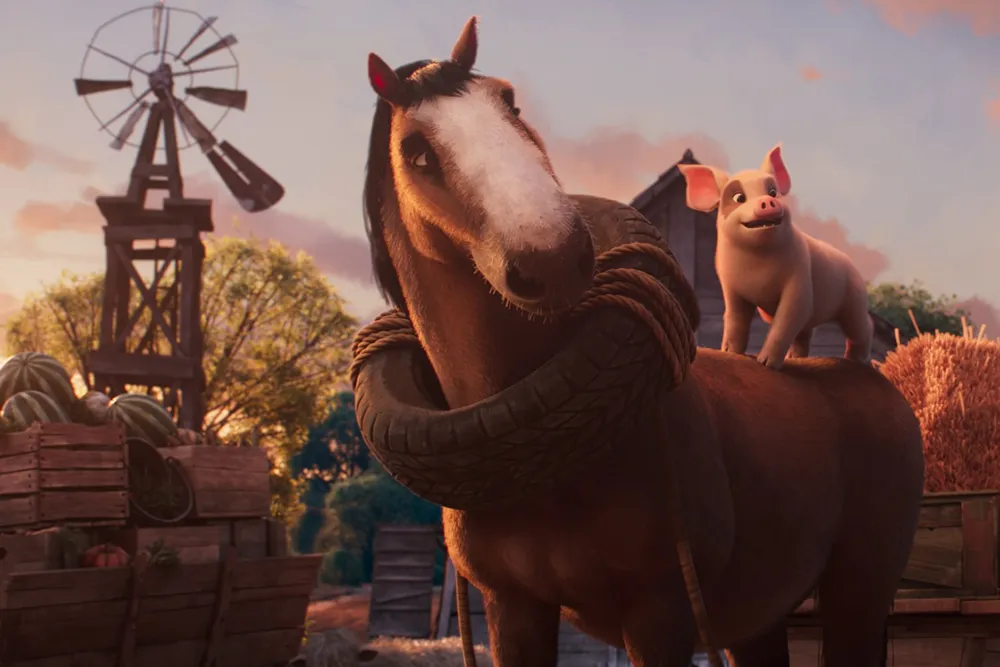
George Orwell is buried in a quiet village in the English countryside — his body lies in the Sutton Courtenay All Saints’ parish churchyard, his grave adorned with copies of his influential books and animal figurines to honor his legacy. Hopefully, all his writing about revolution prepared him for an eternal afterlife of turning in his grave.
“Animal Farm” (2025) is the third attempt at adapting George Orwell’s novella for the big screen. The first was commissioned by the CIA; the second was a straight-to-DVD remake of the first; and this one, even with its star-studded cast, has not broken the curse. The adaptation was announced in 2011, and while the movie had its international release in 2025, the American theatrical release was on May 1 with Angel Studios, a distributor known for its “values-based” entertainment.
Director Andy Serkis wanted to adapt the classic allegory after reading it when he was 11. Maybe he should’ve read it a few more times — in form and content, “Animal Farm” (2025) is bona fide slop, as though the barnyard animals got their hooves on, tore up and partially digested Orwell’s text. What emerges from the other side is an incoherent parable, with elements that resemble the original in superficial, almost insidious ways.

A lot of hay has already been made of the movie’s major changes, packaged in unremarkable animation. The plot has been refocused around the original character, Lucky (Gaten Matarazzo), a young pig who acts as an audience surrogate. Old Major, an old boar who catalyzes the animal revolution in the original book, does not appear in this film, which conveniently sets up the dichotomy between the alpha pigs Snowball (Laverne Cox) and Napoleon (Seth Rogen). The message is simple: one pig good, other pig bad (and both pigs groom Lucky).
While there’s merit in attempting to adapt a decades-old allegory for modern audiences, Serkis’ approach is less concerned with politics than with the appearance of politics. The animals go through the motions of revolution — battling humans and scribbling their seven commandments on the silo — but the plot ultimately settles into a generic groove of tried-and-true shorthand, making for an adaptation with very little to say for itself.

The main villain is now a scheming billionaire named Freida Pilkington (Glenn Close), whose motives are just as incomprehensible as her vaguely Southern accent. Pilkington Industries — with its infinitely long warehouses, meddling drones and huge stores — is a portrayal of capitalism whose spectacle dwarfs its substance. Maybe the simplicity appeals to children, though it’s difficult to imagine kids getting hyped about Orwell over Super Mario.
In a similar vein to AI-generated fruit TikToks, “Animal Farm” (2025) possesses an astounding ability to make audiences laugh at absurdity, and that in itself speaks to the quality of this movie. In an attempt to pander to a wider audience, Serkis introduces a lot of comedic elements — there’s a rap cover of “Old MacDonald Had a Farm,” and Squealer (Kieran Culkin) even has a few lines that could pass as funny — but the humor creates tonal incoherence for the majority of the runtime. Though Serkis may think that pigs driving Lamborghinis is a modern and fun take on George Orwell’s message, it is incredibly distracting and cheapens Boxer’s physical decay and eventual death. What should be one of the most powerful parts of the story is ruined (albeit by fits of laughter) because Lucky is dripped out with an entire set of emerald green Nike tech, and has been for the past 30 minutes.

The movie’s concluding scenes oddly feel like a biblical reference to Noah’s ark, but the larger problem is the treatment of Boxer (Woody Harrelson) as a character. “Animal Farm” (2025) is partially told from Boxer’s perspective in the afterlife, and to his credit, Woody Harrelson acts appropriately sweet and confused. But the framing begs the question of why Boxer would celebrate the glory of Lucky, an absentee friend complicit in the system that sent Boxer to the glue factory. There is always the convenient excuse of Boxer’s kindness, but that only highlights Lucky’s luckiness. For some reason, Lucky’s apology, as uninspiring as a kid begging for his Xbox back, is quickly accepted by all of the animals that he had just indirectly tortured for months. Lucky’s half-baked character shows how the movie is unwilling to handle its source material with any care or compassion, which is all the more necessary when making an adaptation for children.
As the surviving animals gaze up into the stars towards the end, they reflect on the moral of the story. Nobody is always right, they cede. But, “You know what is always right? Helping each other.” Like a performative feminist reaching deep into Goodreads for an impressive bell hooks quote, Lucky brings up the dead Boxer, who always worked hard for his friends, and tells the young piglets to always do the same.
It’s ironic that this adaptation ends with the exact kind of spineless platitude Orwell warned against. “Animal Farm” (2025) tries to pass off its ambivalence as wisdom, shuffling past the fact that Boxer’s existence was inextricably bound to his labor, and no amount of headcanoning can make his suffering aspirational. Headcanoning can, however, produce a Boxer-themed bottle of glue, bundled with a digital movie ticket for $19.84 (plus shipping).
Why adapt texts you have no interest in engaging with? Maybe Napoleon offers the clearest answer when he suggests that “There is no ‘supposed to’ — We’re free! For example, I’m about to fart right now.” Destruction, too, can be a type of creative liberty. Napoleon says as much as he lets one rip: “That’s the sound of freedom.”
RATING: 1/5
This story was originally published on El Estoque on May 12, 2026.