




![MORE THAN A GAME. With two diving catches in the outfield, the Lions showed up defensively, aiding in their victory over the Pacers. One catch was made by Atwood, and the other by McGraw. Throughout the game, the Lions knew that it wasn’t just about their victory today. “I think [playing for cancer] makes it bigger than just a game,” McGraw said. “Knowing that you have a bigger impact in this world than just who you are as one person.”](https://bestofsno.com/wp-content/uploads/2026/05/I70A1454-1-1200x800.jpg)


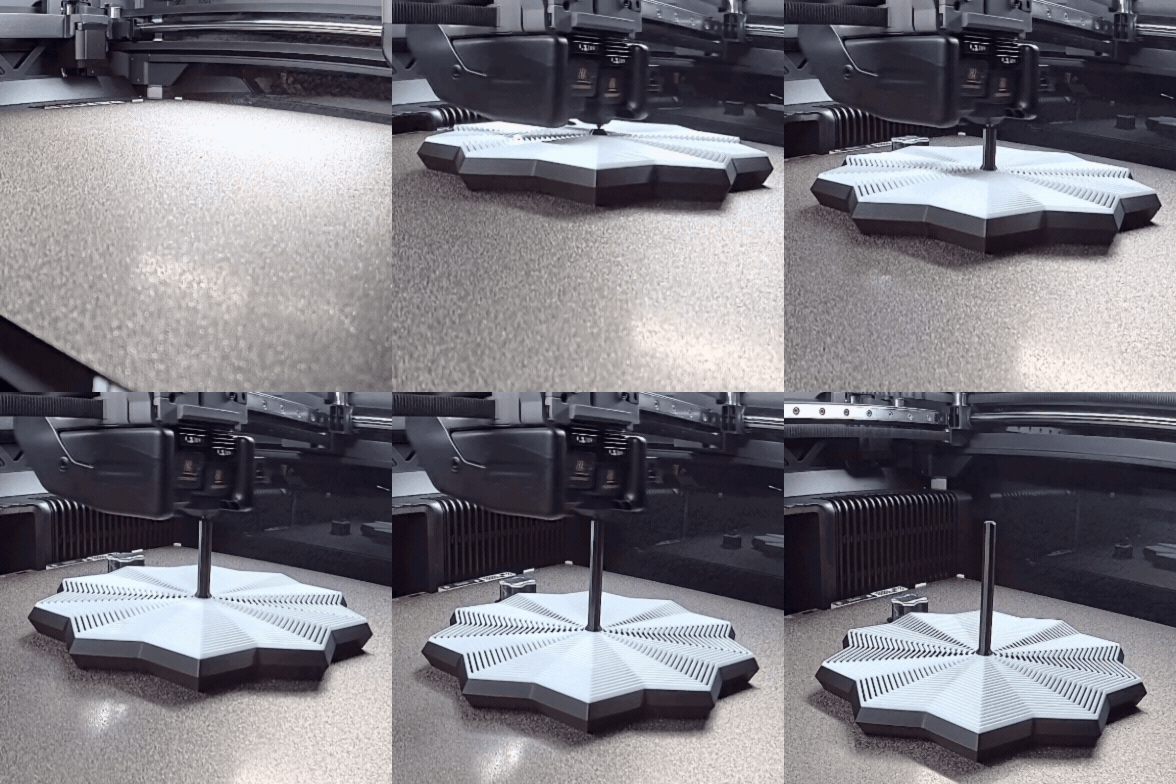
A computer, a spool of plastic filament, and a few hours are now enough for students to manufacture physical objects inside their classrooms, possibly leading to intellectual property violations.
Across Plymouth-Canton Community Schools (P-CCS), students are designing everything from mechanical parts to works of art using machines that, only a decade ago, were reserved for high-end industrial workshops. Through rapid innovation in the industry, 3D printers now echo through classroom settings, turning digital files into physical objects, layer by layer, for the cost of a few dollars in filament. This emerging technology is seen as a great tool until plastic prints start looking suspiciously like something from a movie. As it turns out, these popular 3D prints may be in violation of intellectual property laws.

In Plymouth-Canton Educational Park’s STEM Academy Engineering Pathway, ideas that were once locked behind extensive machining that could take days can now be printed, tested, and redesigned before the school day ends.
“There’s so many things that are impractical to do physically,” said engineering pathway senior Faith Jungkuntz. “It would take forever to try to mill something or carve it out. I have much more freedom with the designs I can create and actually get to physically exist.”
That freedom reaches far beyond what students design themselves. Online 3D model repositories such as Thingiverse, Makerworld, and Printables have quickly grown alongside the creative tool. These databases house millions of user-uploaded STL files, which are digital blueprints 3D printers use to build objects layer by layer.
Replacement parts and engineering tools sit right alongside movie characters and branded products. As these printers became cheaper and easier to use, the convenience of using these sites increased, but that convenience comes with legal complications.
Some files are shared legally through open-source or Creative Commons licenses. Others include copyrighted characters, trademarked logos, or patented designs uploaded without permission.
There is no major U.S. court case that has focused specifically on K-12 students printing copyrighted STL files, and Michigan has no state law around classroom 3D printing; however, existing copyright, trademark and patent laws can still apply regardless of where an object is produced.
Yet in practice, disputes usually target commercial harm rather than classroom use.
Alex Turk, a patent clerk at Bodman PLC, said “IP holders are more interested in protecting their IP rights when somebody else is infringing and making money off of the infringement. IP and civil law is not about punishing wrongdoers. It’s about making the harmed party whole.”
For schools, that leaves much of 3D printing to fall under the umbrella of broad technology policies rather than rules written specifically for digital production.
P-CCS has no standalone policy addressing intellectual property and 3D printing. Students’ activity instead falls under existing technology use expectations outlined in the P-CCS K-12 Student Handbook and board policies.
District guidelines prohibit the use of unauthorized software, unethical technology use, and unlicensed digital media, but they do not directly address downloadable STL files or online model databases.
This gap reflects just how quickly the technology has evolved.
Christoper Hren, a chemistry and engineering teacher at Canton High School, said modern 3D printers have transformed from unreliable devices into classroom tools.
“They’re easy to get. They’re easy to access. They’re easy to use,” Hren said. “They’ve changed so much in the last few years.”
The machines change the pace of classroom engineering. Students can design prototypes digitally, print them overnight and return the next morning ready to test their models, revise measurements, or go back to the drawing board.

“There’s a lot of trial and error,” Jungkuntz said, recalling hours of troubleshooting.
“Sometimes, when you get a printer that’s a little overused, it can be a struggle to get it to print properly and not just die out on you because it’s running down. Sometimes there’s actual limitations in the designs, like hollow spaces inside an object that the printer can’t print without supports, but then it’s no longer hollow,” she said.
Warped edges, broken supports, bad bed adhesion, and failed prints have become part of the learning process itself, forcing students to think through the manufacturing process in ways classroom modeling alone cannot achieve.
District leaders say that kind of problem-solving is exactly why schools like P-CCS continue to invest in technologies such as 3D printing and artificial intelligence.
“I think 3D printing has a lot of value in so many industries,” said Anupam Chugh Sidhu, vice president of the Plymouth-Canton Board of Education. “If our students can get exposure to [3D printing], along with engineering and coding, our students are going to be better off in the workplace.”
Yet while schools supervise these printers, they cannot control what the popular online file repositories are feeding them.
When asked about a specific database commonly used in the classroom, Sidhu said, “Plymouth-Canton doesn’t control that site, so everything that’s on there should be used with caution.”
While teachers oversee safety procedures and machine operation, they are not typically expected to investigate the intellectual property status of every file before a print begins.
That leaves much of the responsibility on students themselves, many of whom may not realize the legal ambiguity surrounding what they print.
“Frankly, maybe this is not super responsible, but I often don’t think about it,” Jungkuntz said. “I think it’s just as the consumer, I would assume that if it’s out there and people are printing it, I’m not going to consider it to be an intellectual property violation.”
That assumption reflects a larger reality around 3D printing: the technology has become mainstream faster than most people fully understand the legal boundaries that come with it.
For now, classroom printing remains educational and noncommercial, a distinction that often reduces the likelihood of companies pursuing legal action.
Still, Turk noted that some companies are known for aggressively defending their intellectual property even in smaller cases. “Nothing stops a lawyer from sending a cease and desist,” he said.
Until courts and lawmakers more clearly define those boundaries, schools across the country continue to teach students with technology capable of reproducing almost anything, while the legal precedent of that is still being put into place.
“The law tends to lag,” Turk said. “The law will only catch up to developments in tech and science when there’s a case or controversy over it.”
This story was originally published on The Perspective on May 21, 2026.