





![MORE THAN A GAME. With two diving catches in the outfield, the Lions showed up defensively, aiding in their victory over the Pacers. One catch was made by Atwood, and the other by McGraw. Throughout the game, the Lions knew that it wasn’t just about their victory today. “I think [playing for cancer] makes it bigger than just a game,” McGraw said. “Knowing that you have a bigger impact in this world than just who you are as one person.”](https://bestofsno.com/wp-content/uploads/2026/05/I70A1454-1-1200x800.jpg)


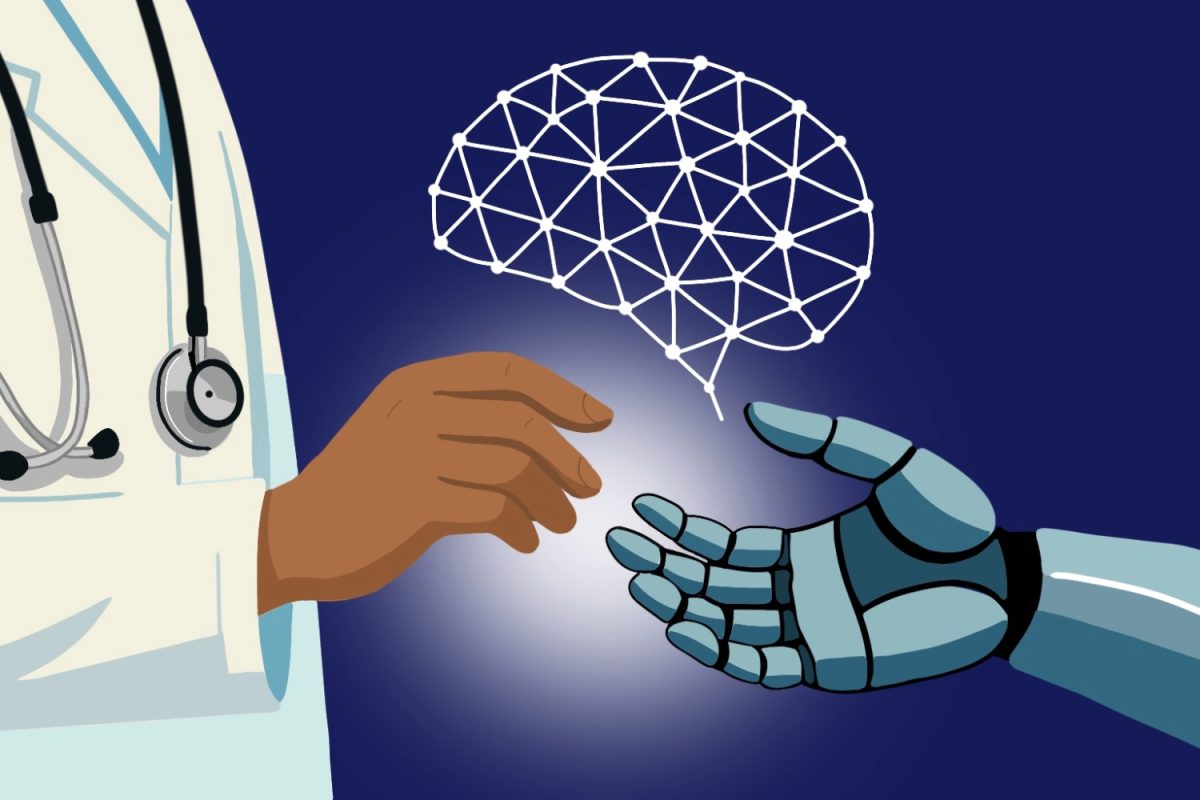
Four years of college, four years of medical school, five years of residency, and 13 years of one’s life dedicated to becoming a doctor — yet artificial intelligence (AI) is now learning to diagnose and treat illnesses in a fraction of that time.
AI has become increasingly prominent in healthcare, influencing decision-making, shaping workforce dynamics, and helping to alleviate burnout. This is because AI can perform 30-40% of medical tasks, allowing workers to focus on complex, patient-centered care, as reported in an article about technological innovation in healthcare by the National Library of Medicine.
For immunologist Julia Cronin, who works at Sutter Health Palo Alto Medical Foundation, the shift toward AI became personal about a year ago when she was first introduced to an AI technology called Abridge. Abridge is an app that listens to patient visits through a phone and, at the end, uses AI to generate feedback on possible diagnoses and summarizes the conversation in notes.
“It will make things that I’ve said almost sound better than the way I said them, and put them in an organized form,” Cronin said. “At the end of the visit, sometimes I don’t need to do much for my assessment and plan. It’s already done for me.”
Cronin initially didn’t see a need for Abridge, as she already worked with a human scribe, which is a person who listens remotely over the phone to summarize patient visits. However, about six months ago, she began using Abridge along with her scribe.
“More just to augment what my scribe does. And on the days or times when my scribe wasn’t available,” Cronin said
Although Abridge has helped Cronin save time on documentation, it isn’t flawless. According to an article about AI scribe technology by the National Library of Medicine, AI scribe applications are still in the early adoption phase; they may struggle with issues such as voice differentiation and context interpretation.
Cronin has encountered these limitations firsthand as Abridge sometimes struggles to distinguish information between multiple family members and to interpret context. For instance, when she explains test results or performs an examination, Cronin occasionally has to edit the entire transcript generated by Abridge due to transcription errors.
Still, with both Abridge and her scribe, Cronin’s overall documentation time has decreased significantly.
“I have one coworker who says she wants to cry if she leaves her phone in her desk and forgets to bring it in the room, because she knows that the visit will take like five times as long,” Cronin said.
Cronin believes Sutter Health may be considering discontinuing scribe services, as Abridge is significantly less expensive. According to the National Library of Medicine, AI scribe systems cost approximately $100 per month for each user, compared to the average monthly salary of a human medical scribe, which is around $2,800.
Additionally, patients have expressed a preference for Abridge over human scribes, as they feel uncomfortable sharing private information with another person listening in.
“Scribes get sick, they call out, they’re in other countries, I didn’t have a scribe one time for about a week,” Cronin said.
According to an article by the National Library of Medicine on balancing technological innovation in healthcare, the shift towards AI in healthcare raises concerns for administrative roles in the medical field, as hospitals may face financial pressure to adopt more cost-effective methods. Without strong workforce protections, AI administrative technology could lead to job displacement for workers whose responsibilities are largely automated.
On the other hand, AI scribes improve doctor-patient interactions by eliminating the need for clinicians to focus on computer screens during appointments. With AI handling documentation, doctors can maintain eye contact, observe body language, and give their full attention to patients, according to the National Library of Medicine.
Sutter Health is also trialing the use of AI for responding to patient messages, with the AI providing doctors with a draft reply to review and send according to Cronin.
“Sometimes I’ll actually use those. They’re pretty good. Sometimes they’re horrible,” Cronin said.
While Cronin’s specialty is only beginning to use AI, radiology has been leading the charge for nearly two decades. The field accounts for 18% of all AI-related medical publications from 2003 to 2023, and produced 14,228 papers between 2021-2023, as reported in an article about emerging AI trends in healthcare by the National Library of Medicine.
Radiologist Justin Shafa first began noticing the emergence of AI platforms back in 2019. Today, he uses tools such as Rad AI and Gleamer AI to assist in tasks ranging from detecting bone fractures in X-rays to identifying brain bleeds, pulmonary embolisms, and interpreting CT scans.
These platforms have enabled Shafa to catch details he might have missed, and have helped him save time overall.
“They should make us faster and more accurate. They’re not 100%, in any capacity. They’re not perfect,” Shafa said. ”Sometimes they make embarrassing mistakes; it can miss a fracture, it can say something’s a fracture when it isn’t.”
The imperfections Cronin sees in Abridge mirror the obstacles Shafa encounters in radiology. According to an article on balancing technological innovation in healthcare by the National Library of Medicine, the challenges AI faces stem from the way it learns.
AI analyzes large amounts of patient data to make decisions; its accuracy depends heavily on the diversity and representation in the data.
When certain groups are underrepresented, the AI’s performance can suffer, leading to biased or unreliable results. For instance, a 2019 AI model developed by DeepMind for predicting kidney injury performed worse for women due to their underrepresentation in the training data.
“There is a lot of wrong detection that AI labels incorrectly. This is why human observation is still needed to properly diagnose a patient,” said Carlos Buitrago Pizon, a technologist in interventional radiology.
Cronin believes AI will play a significant role in the future of medicine, and many doctors are grateful for the support it provides. However, she hopes to see further improvements, including specialty-specific scribes and AI-assisted precharting.
“Specialty-specific scribes would be amazing, if AI learns our templates and they’re putting what we say directly into a template that we use, that could be even more helpful,” Cronin said. “The other thing, AI could be able to pre-chart, which is the day before, when I go in and see who’s coming. Sometimes I like to put some info in the chart just about the records, AI could help with that.”
This story was originally published on Scot Scoop News on April 20, 2026.