




![MORE THAN A GAME. With two diving catches in the outfield, the Lions showed up defensively, aiding in their victory over the Pacers. One catch was made by Atwood, and the other by McGraw. Throughout the game, the Lions knew that it wasn’t just about their victory today. “I think [playing for cancer] makes it bigger than just a game,” McGraw said. “Knowing that you have a bigger impact in this world than just who you are as one person.”](https://bestofsno.com/wp-content/uploads/2026/05/I70A1454-1-1200x800.jpg)


Lyra, a red-tailed hawk capable of flying 120 miles per hour, takes off in seconds to descend from the top of a dark, 300-seat theater at the Aquarium of the Pacific.
The raptor glides silently above the audience’s heads as they gaze in awe before she lands on the perch that is Katrina Wilbanks’ gloved hand.
Her 5-foot wingspan engulfs Wilbanks, a 2012 El Camino College graduate, who stands only a few inches taller.
“She’s large and in charge,” she said later.
The flight brings the daily “Birds of the Pacific” show to a close at the aquarium in Long Beach, where Wilbanks has worked since October 2023 as an aviculturist caring for a menagerie of birds.
She takes on many roles as a keeper, including preparing food, feeding, cleaning, gardening, training and tracking the animals’ behaviors, as well as protecting and advocating for them in their exhibits.
“They don’t have a voice, so I try to use mine to better their life here,” she said.
The fast-paced nature of working at Southern California’s largest aquarium, which opened in 1998 and now welcomes about 1.5 million visitors annually, keeps the bubbly-voiced Wilbanks on her toes.
“There’s something different every day, the animals do whatever they want,” she said.
Wearing running shoes and socks with cat faces, she’s light on her feet. At work, her colleagues know her best by her nickname, “Kat.”
She works from 7 a.m. to 4 p.m., and her daily tasks vary among the 20-member animal husbandry team.
Her light straw-colored ponytail falls on her uniform, a navy polo and khaki shorts. The combination echoes the rare coloration of her right eye, which is ocean blue with a brown spot — a trait from her mom.
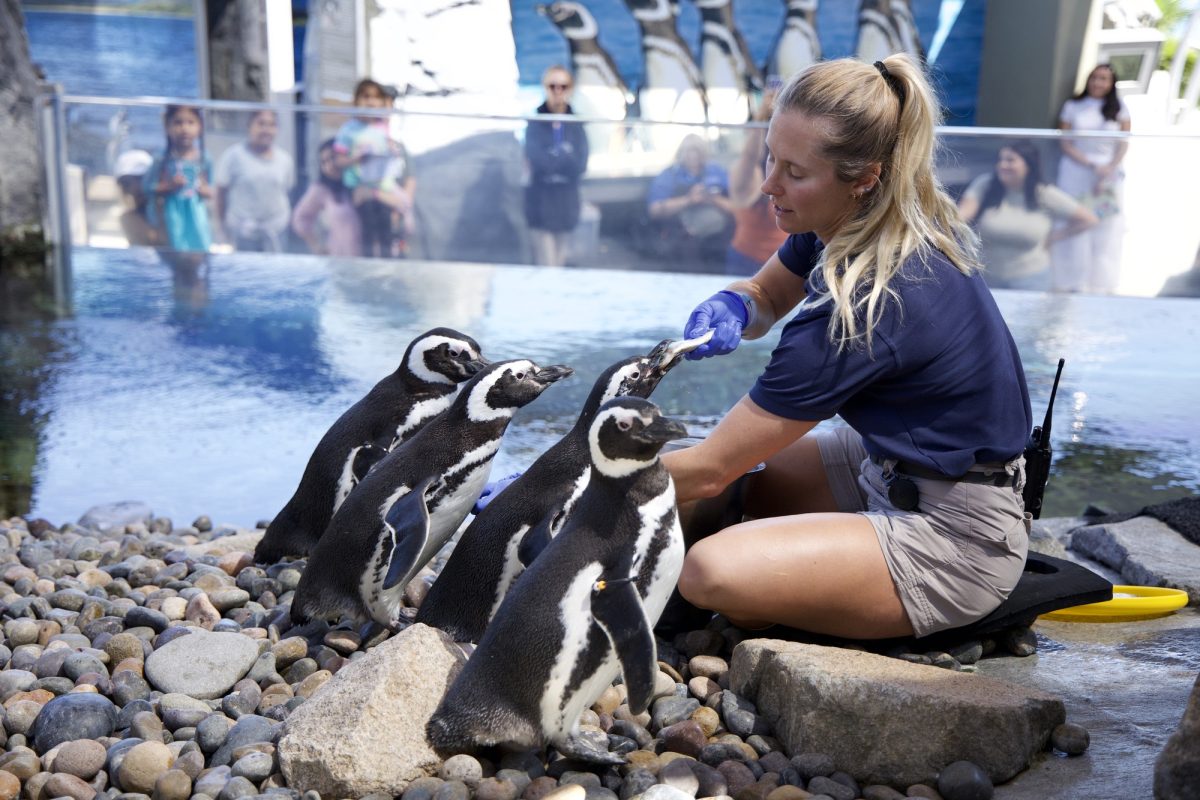
After the bird show, the alumna looks at her turquoise wristwatch. She’s on time to feed the penguins their capelin and herring dinner at 2:30 p.m.
From a penguin not feeling hungry for seafood at meal time to Freyja the raven choosing whether or not to solve a puzzle during show time, the aquarium’s residents are free to choose what they do.
But while the animals are decisive, Wilbanks herself didn’t always know she wanted to be a zookeeper.
Finding her wings
At El Camino, Wilbanks earned a general science degree with honors and pole-vaulted her way as a student athlete on the track and field team to a near-full scholarship at California State University, Northridge, in 2013.
However, studying kinesiology at Northridge left her unfulfilled.
She needed a major change.
“OK, what’s the coolest thing I could ever hope to do?” Wilbanks, now 33, recalls wondering.
Thinking back to her childhood aspirations, she was transported back to the sixth grade in Torrance.
After school, her parents would turn the Animal Planet channel on in their living room and she’d watch zookeeper Steve Irwin’s TV shows.
Memories of the late, famed crocodile wrangler inspired her to switch her major to biology and become a zookeeper, which she said would be “pretty cool.”
“I always remember him having the utmost respect for animals and just the animal kingdom and the environment that we live in and just being really conscientious about that,” she said.
Wilbanks, who graduated from Northridge in 2015, said her parents and younger brother, who works in information technology, were excited for her newfound career path.
Six zoos later and 11 years in the making, Wilbanks’ work with animals has flown her across the country and the world to tackle unpaid internships as well as seasonal and full-time positions.
Aviculturist, a bird care specialist
Climbing up and down staircases, she slides over and under the aquarium’s life support system water pipes, navigating dimly-lit spaces guarded by staff-only signs.
After zooming through warm-hued halls and cubicles, she wipes her gray sneakers on a soft mat and passes into the fishy-smelling, metallic kitchen.
She’ll take live meal worms and restaurant-quality seafood from the walk-in fridge or simply bring back dishes on her way to and from the bird’s exhibits.
Fitting for her athletic nature, Wilbanks describes her spirit animal as a hummingbird, sharing both fast heart rates and large appetites despite their tiny frames.
Birds of a feather
Specializing in birds was also as unexpected for her as zookeeping.
Her first encounter with birds was in 2016 at the Indianapolis Zoo as a seasonal worker.
“I honestly at that point would not have picked birds like at all … It’s not really the animal I want, but that was my first paid job,” she said.
But some of their charming natures, shining through their often discordant chirping, started to nip at her heart.
“Full of personality, each and every one of them,” she said.
A year later, her next job was as a wildlife theater trainer at the Denver Zoo, being part of a free-flighted bird show that included slow-mammals.
Audiences watched as crowned cranes walked across the stage, porcupines meandered, tamandua anteaters slowly climbed and every bird from hawks and owls to macaws and vultures soared.
The show wasn’t as effortless as it seemed, Wilbanks said, when she worked behind the scenes in a “catch and release” fashion. Each animal had to be locked and secured before the next one could make its entrance.
“We had fly offs like crown cranes where now the speaker has to stall the audience because the show actually cannot go on because I need to go collect that bird,” she said. “And sometimes they would just, like the Macaw, sit up in the tree.”
Then the show would end for the team to stare up at the bird, thinking, “They’ll come down eventually.”
But Wilbanks said one of the scariest parts of the job was the show’s popularity.
She was sometimes put on the spot with public speaking — an activity which ranks at No. 46 in the list of Americans’ biggest fears, according to Chapman University’s 2025 study.
Fortunately, her seasonal position meant she didn’t have to go through a main role on stage.
“Every day was so different. The people, the full-timers, were definitely some personalities. Like to do the show, you are outgoing, ecstatic, like you have so much energy,” she said.
The Denver Zoo was also where she learned to handle birds of prey with one free hand and the other gloved amid their sharp talons, like she does now with Lyra. “I’m a raptor girl and I really like them,” she said.
From Denver she flew around the globe to Australia in 2018, finding work in Sydney as a health and wellness consultant at Arbonne — a company for humans.
But she couldn’t stay too far away from the animals.
For two weeks, she moved up north to Magnetic Island, located off the coast of Queensland and about 30 miles away from the Great Barrier Reef, to volunteer at The Koala Park in exchange for food and board.
“They were like, ‘Wait, you actually work with animals back home? This is crazy. … Could you please stay?’” Wilbanks said.
A competitive, growing industry
Returning to Southern California was always “endgame,” she said, but the job market was competitive coming back from Australia in 2019.
Out of the 50 or so applications she sent, she heard back from about two employers, and in one pool, she was chosen from around 150 other job seekers to work at the Lincoln Children’s Zoo in Lincoln, Nebraska.
The animal care and services field, which includes jobs working with pets as well as zoo animals, is projected to grow much faster than average, 11% by 2034, according to the U.S. Bureau of Labor Statistics.
Joseph Nappi, president of the American Association of Zoo Keepers, said zookeeping specifically is a relatively static industry in terms of growth because the demand for positions surpasses zoo facilities.
“It is a very competitive field because, I mean, who wouldn’t want to work with animals? So you have to really set yourself apart while you’re in college especially to really stand out, and often people have to be willing to move across the country,” Nappi said.
“Kat” and the big cats
In Lincoln, Wilbanks worked with carnivorous animals including wallabies, river otters, bobcats, snow leopards and fossa, highlighted as a fearsome predator in Dreamworks’ 2005 animated film, “Madagascar.”
Behind the scenes, exhibits had to be cleaned and the big cats secured in a separate space before she enters.
“One of the things with zookeepers is, ‘Did I lock that lock?’” she said. “You’ll go home sometimes and be like, ‘Did I?’”
For Wilbanks, who worked alone in her exhibits, the worry would bear on her mind enough for her to call a late-shift colleague to check, but the locks were always secure.
“So, that job I started to learn what anxiety was. I did not really know or feel what it was until that year in Nebraska,” she said.
Yet, one of her most favorite moments as a zookeeper happened in Lincoln when she was checking on the river otters.
Opening their boxes, she had to do a double take: Three otter pups.
It was a total surprise to the staff.
“Seeing the baby otters for the first time, that blew my mind and will forever be ingrained in my memory,” she said.
Female otters are able to delay the implantation of their fertilized eggs, making babies more uncommon.
From Nebraska, she moved to the Lone Star State for two years, working at the Downtown Aquarium in Houston in 2021 and the San Antonio Zoo in 2022.
Keeping on zookeeping
Up until her work in Texas, she also had to work mostly part-time restaurant server jobs.
In her career, she didn’t want to be limited to the nearby South Bay zoos and didn’t want to wait around.
“You have a higher success rate of just going to the places that nobody really wants to be, like Kansas, like Nebraska,” she said. “It was easier to get my foot in the door there than to wait here back home where there’s way more people who want this job who are willing to wait it out.”
El Camino biology professor Bryan Carey similarly recommends that students take related classes including marine biology, transfer and get involved with local zoos, aquariums and other facilities.
“It’s also about trying to get your foot in the door, as they say, and being able to [do] even just some volunteering that sometimes translates into other opportunities,” Carey said.
A strong background
While Wilbanks didn’t get a head start by volunteering with animals before college, her athletic background built the muscle and endurance needed to keep up with large cats and flighty birds.
From a young age, Wilbanks’ parents supported her in any sport she wanted to try, including soccer, swimming, softball, tennis, track and her favorite: volleyball.
When she went to West Torrance High School, she didn’t make the volleyball team. So she focused on track and pole vaulting.
She continued the sport at El Camino, where she set a pole vaulting record of 12 feet during the South Coast Conference in 2012.
“I remember that day like it was yesterday,” she said. She was scouted right then by a Northridge recruiter.
Her name was on a plaque at El Camino for over a decade until just last spring, when her record was bested by three fourths of an inch. Coach Kevin Hughley shared the news with her in a text.
Wilbanks was excited.
“That was such a hard footage to beat and for me to get to,” she said.
Medium to heavy strength levels, frequently lifting up to 50 and sometimes 100 pounds, are needed daily from 76% of animal caretakers, including zookeepers, according to the U.S. Bureau of Labor Statistics.
It’s also a stand up job — with workers being on their feet for 82% of the workday.
Nappi, a senior keeper at the Bronx Zoo, said women now represent the majority of zookeepers in what used to be a heavily male-dominated field, in part due to the physical demands.
“[It’s] hard to say exactly why that may be. I don’t know if it’s like a nurturing thing, but it’s just totally changed,” Nappi said.
Working at the Aquarium of the Pacific, Wilbanks’ journey has come full circle as she lives in Torrance with her parents and their two cats and dog.
Working with tuxedoed friends
Feeding penguins at the aquarium, Wilbanks is assisted by volunteer Leala Stephenson in tallying the number of fish each penguin eats and their behavior.
Wilbanks notes the behavior of Anderson, a sassy male who hatched at the aquarium close to 13 years ago, and offers fish to the penguins swimming in the exhibit’s chilly, 60-degree water or brooding in their rocky holes.
The penguins, tuxedoed for a black-tie affair, swallow fish whole and make loud vocalizations described as donkey-like brays.
Stephenson, who has also taken classes at El Camino, is one of the aquarium’s estimated 1,000 volunteers. She started last year and sometimes helps with the penguins, where Wilbanks is often found.
“She has got so much positive energy, she’s so effervescent, she’s just got a good vibe,” Stephenson, 54, said. “Very smart, very thoughtful, great with the animals and great with the volunteers.”
Free as a bird
Wilbanks had only liked birds — not loved them — until her last job working with waterfowl and flamingos as an animal care specialist at the San Antonio Zoo. She realized avian species were her favorite animals.
“Like this is it,” she said. Although beaks and claws still pose an occupational hazard, she appreciates the lesser danger of birds compared to other, larger zoo animals.
“So that puts my mind more at ease, whether I’m thinking of a lock that I have to check or if I have to pick you up, are you going to injure me,” she said.
She also enjoyed their personalities.
“I didn’t think that they were going to be so, so different from individual to individual within a species or from species to species. They are so different,” she said.
She also enjoyed learning what they found interesting and how they wanted to spend their time.
Outside of work, Wilbanks herself has many interests. As a hummingbird goes flower to flower, she goes hobby to hobby, she said.
Many avian species, more hobbies
Baking bread and pastries, drawing, crocheting, rock climbing, Pilates, yoga and volleyball are among her growing list of activities.
She also does photography and watercolors, with birds being the often subject, and hopes to exhibit her artwork in a gallery.
Looking at birds — by birding or birdwatching — is another pastime of hers, which started after working with them in Texas. She warns it’s addicting, like “adult Pokémon.”
“I just started noticing them more in my world, environment and then now it’s just an obsession,” she said. “I’m always looking for birds and trying to identify them.”
So far, she’s seen 230 birds over her life, keeping track through the Merlin Bird ID app by the Cornell University Lab of Ornithology.
“[Birding] just had a huge spike in popularity around 2020, and now it’s like it just exploded in popularity, especially with a lot of young people,” Frank Izaguirre, marketing and communications manager for the American Birding Association, said.
Accredited, thoughtful care
While avian species in exhibits don’t count for birders, zoos and parks including the Aquarium of the Pacific raise awareness and educate visitors about different species.
The aquarium’s animals are often rescued — including Lyra, whose permanent foot damage prevents her from hunting prey in the wild — when they won’t survive if released.
The Aquarium of the Pacific was re-accredited in March by the Maryland-based Association of Zoos and Aquariums, which certifies facilities upholding high animal welfare standards.
Only about 10% of the zoos and aquariums in the United States receive AZA accreditation.
AZA President Dan Ashe said members describe the accreditation process, which occurs at least every five years, as “exhaustive.”
“It represents the facilities that are really at the top of their game. It’s like the NBA or the NFL of the zoological world. A facility like the Aquarium of the Pacific represents the very, very best,” Ashe said.
The aquarium partners with the AZA’s Species Survival Plan for the healthy breeding of Magellanic penguins under human care.
In the wild, the internationally near-threatened penguins face difficulties breeding and sourcing food — challenges linked to climate change. Four rescues from Brazil make up the aquarium’s colony of 16 penguins, which were added in 2012.
A livestream of the June Keyes Magellanic penguin exhibit can be viewed on the aquarium’s website.
Among some of Wilbanks’ well-traveled coworkers include the blue-throated macaw Benny, native to South America, as well as the lorikeets and cockatoo Lola, native to Australia.
Some of the other rescued locals she works with, like Lyra, include Freyja the common raven, Chief the great horned owl and shorebirds including the threatened snowy plover.
Liliana Griego, senior coastal program manager for Audubon California, said it’s significant for the Aquarium of the Pacific to have the latter species.
“Most people don’t even notice that they’re sharing the beach with the snowy plover,” Griego said. “They’re like this really cute fluff ball of a bird.”
Audubon California partners with the aquarium to restore local wetlands, creating more habitable spaces for shorebirds.
An oasis for animals and people
After feeding the penguins, Wilbanks hums through the building, set on a six-acre site.
Outdoors, Wilbanks checks on Batman the yellow-crowned night heron, where he lives in the Wetlands exhibit among the daisies and rosemary she planted.

“We really try to make it as naturalistic as possible,” Wilbanks, one of the aquarium’s self-described “plant ladies,” said. “We try to get plants that were native to the area that they [the animals] are found.”
Batman perches so quietly in his habitat, located across from a gift store with plush animals, most visitors question whether he’s real or a toy. He lives right across from the Lorikeet Forest, a large, mesh-enclosed aviary.
Wilbanks loves her “stolen moments” with the rainbow lorikeets.
But her favorite exhibit, “hands down,” is the Shorebird Sanctuary, a multi-species space featuring three species of fish and several birds.
The land-and-sea style exhibit’s tide, which sparkles with iridescence in the sunlight, fluctuates daily.
“Being in there — if you didn’t see the windows, didn’t see the mesh — you feel like you could be out in the wild. It’s just so serene and peaceful, and there’s also birds,” Wilbanks said. “I could get lost in there.”
Like her many feathered friends, her near-and-far career journey resembles a migratory pattern of her own making.
“Job-wise, I don’t really know what they have in store for me at work,” Wilbanks said. “I’m just there along for the ride.”
This story was originally published on El Camino College Union on May 20, 2026.